


Staring at a sea of faces, heart pounding in your chest, you feel that familiar knot of anxiety. You have something important to share, but what if they don't listen? What if you can't hold their attention? This fear of fading into the background is a universal one, whether you're on a literal stage, in a boardroom, or giving a wedding toast.
But imagine stepping out with an unshakeable sense of command. Imagine holding the entire room's attention, not with cheap tricks, but with an authentic, magnetic energy. That power isn’t a secret gift for the lucky few—it's a skill called stage presence, and you are absolutely capable of mastering it.
This guide is your roadmap. We’ll break down the practical, actionable steps to transform nervous energy into genuine charisma, helping you connect, persuade, and leave a lasting impact every single time.
What is Stage Presence (And Why Does It Matter)?
Think about the most memorable speaker or performer you’ve ever seen. What made them so compelling? It wasn’t just their words or their talent. It was their presence—an almost tangible aura of confidence and authority that made you lean in and listen.
That magnetic quality is the essence of stage presence. It’s a powerful combination of mindset, body language, and vocal delivery that forges a real connection with an audience. It's not about being an extrovert; it's about projecting authenticity and control.
The Psychology of Connection
Stage presence is often mistaken for a personality trait, but research shows it’s a skill you can cultivate. A study published in the Journal of Experimental Social Psychology found that a performer's mindset directly impacts audience engagement. When performers adopt an "opening night enthusiasm" for every event, their impact skyrockets. They become more memorable and persuasive.
The 4 Core Pillars of Unforgettable Presence
True stage presence is a cocktail of key elements working in perfect sync. You must project confidence before you even say a word.
Let's break it down into four critical pillars:
- Mindset Mastery: This is your internal game. It's about conquering self-doubt and channeling nervous energy into focused excitement.
- Physical Command: How you use your body speaks volumes. Purposeful movement and strong posture project confidence from a mile away. Learn more about mastering these non-verbal cues by exploring what is body language in communication.
- Vocal Dynamics: Your voice is your most powerful instrument. Learning to vary your pitch, pace, and volume is what keeps people hanging on every word.
- Audience Connection: This is the ultimate goal. It's about making every person in the room feel seen, understood, and engaged.
By the end of this guide, you'll have a practical toolkit to develop a presence that commands attention and leaves a mark on any audience.
1. Master Your Mindset Before You Step Onstage
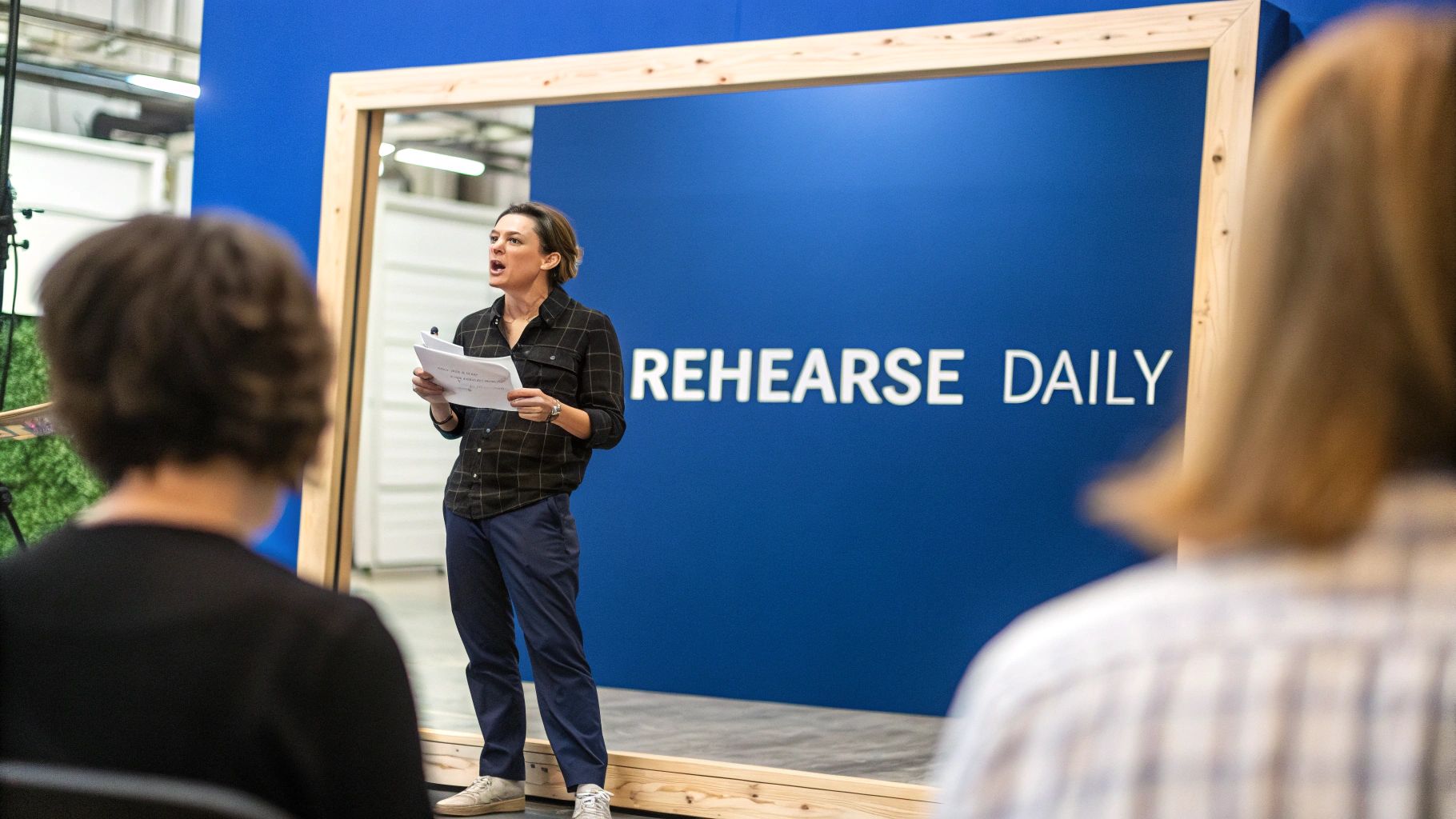
Let's be honest. The biggest barrier to a commanding stage presence isn't the audience—it's that frantic, critical voice inside your head.
That sudden rush of anxiety, the sweaty palms, the racing heart? It's a completely normal 'fight-or-flight' response. Your body thinks it’s in danger. Instead of trying to crush that feeling, the key is to reframe it and use it as fuel.
You're not alone in this. Glossophobia, the fear of public speaking, impacts a huge number of people—up to 77% of the population feels some anxiety before getting in front of a crowd. The pros aren't fearless; they've just learned how to manage that nervous energy. This starts with a solid pre-performance ritual.
Tame Anxiety with Visualization and Breathwork
Your brain often can't tell the difference between a real memory and a vividly imagined one. You can use this to your advantage.
Before you go on, find a quiet space. Close your eyes and mentally walk through a successful performance. Picture yourself striding out with great posture. Nail your opening line. See the audience engaged, nodding along. Feel the applause.
This mental rehearsal creates a neurological blueprint for success. When you actually step out, it feels less like a terrifying unknown and more like something you've already accomplished.
Key Takeaway: Stop trying to eliminate nervous energy. Instead, transform the narrative. Flip the switch from "I'm scared" to "I'm excited." This simple cognitive shift can fundamentally change your entire performance.
Pair this with a simple breathing exercise. The 4-7-8 breathing technique is a game-changer for calming nerves on the spot:
- Breathe in quietly through your nose for 4 seconds.
- Hold your breath for 7 seconds.
- Breathe out completely through your mouth for 8 seconds.
Repeat this three or four times. It physically slows your heart rate, pulling you out of an anxious thought spiral and back into the present moment.
Adopt a Power Pose to Shift Your Physiology
Your body language sends powerful signals back to your own brain. Standing in an expansive, confident posture—even for just two minutes—can actually change your body's chemistry.
Think of the "superhero" pose: feet shoulder-width apart, hands on your hips, chest open, chin held high. It might feel silly, but studies by social psychologist Amy Cuddy show that holding such poses can decrease cortisol (the stress hormone) and increase testosterone (linked to confidence). It’s a physical hack that triggers a real mental shift.
For a deeper dive, check out our guide on overcoming public speaking anxiety. You can also find more practical tips here: essential tips for a killer best man speech.
2. Command Your Space With Purposeful Movement
Once your head is in the game, it's time to get your body on board. The stage is a tool. How you move on it tells a story before you utter a single word.
Great performers don't just stand there like statues, nor do they pace like caged animals. Every step, gesture, and shift in position has intention. This is how you turn nervous energy into confident, authoritative movement that amplifies your message.
Own Your Territory: How to Use the Stage
The second you step on stage, that entire space belongs to you. Many people hide behind a podium or glue their feet to one spot. Don't. Use every square inch you have.
Planning your movement can completely change your delivery. Know where you'll enter, where you'll stand for key points, and where you'll move for transitions. You can find excellent advice on mastering physical movement over at Suasive.com.
This is where your body language becomes a massive part of your performance.
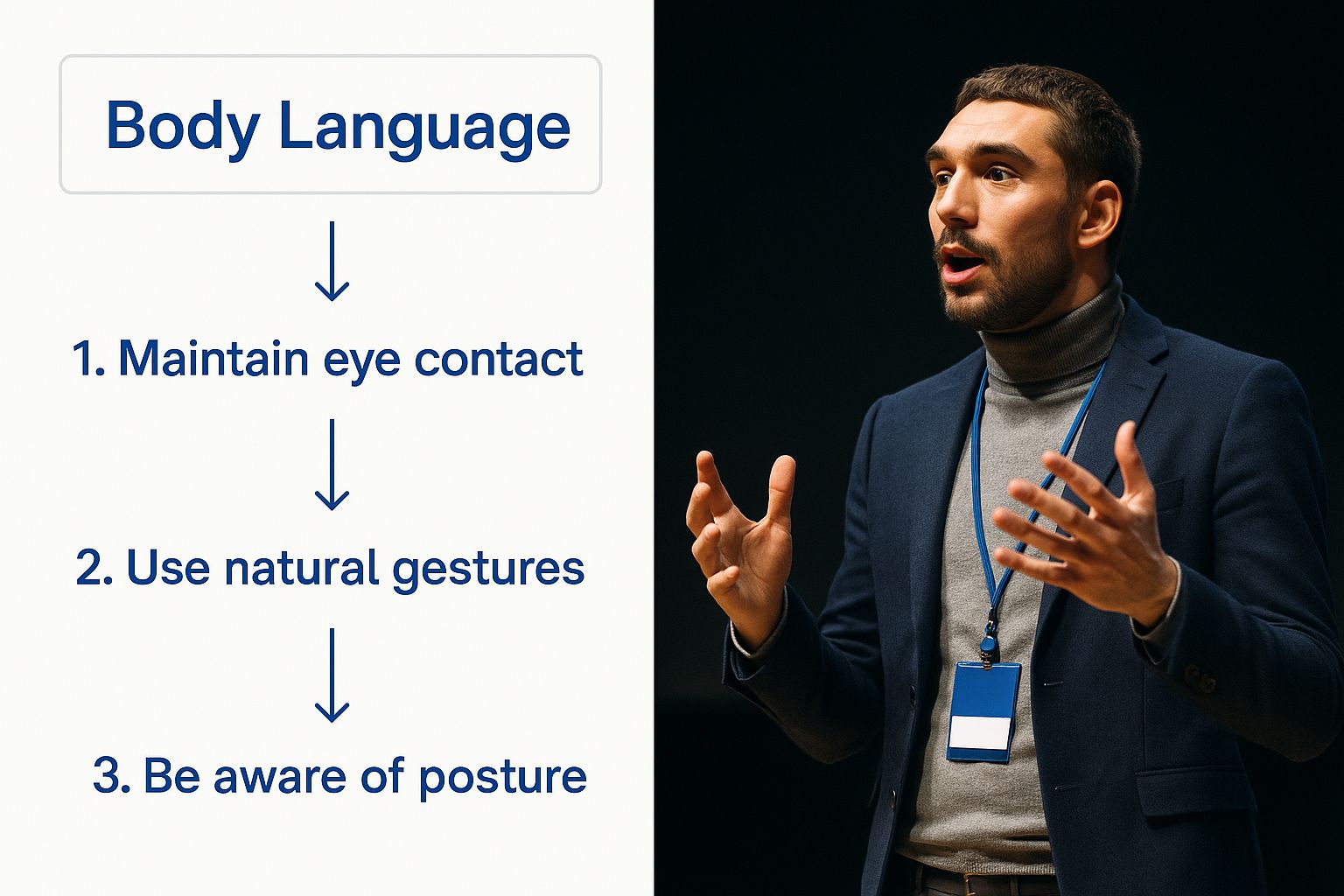
Expressive and open gestures build a visual story that backs up your words. It's what makes a talk memorable instead of just... a talk.
Think of the stage in zones, each with a purpose:
- Center Stage: Your power position. Your home base. Deliver your most important points from here.
- Stage Left/Right: Move to the sides when telling a story, offering a different perspective, or shifting to a new topic. It signals a change.
- Forward Movement: Want to create intimacy or drive a point home? Take a few steps closer to the audience.
Choreographing your movement adds a new dimension to your message. It’s the difference between a static presentation and a dynamic experience.
Stage Movement Do's and Don'ts
| Effective Movement (Do) | Ineffective Movement (Don't) |
|---|---|
| Move with clear purpose to signal a new idea. | Pace back and forth nervously without direction. |
| Use the entire stage space, from left to right. | Stay frozen in one spot, especially behind a podium. |
| Step forward to connect with the audience on key points. | Turn your back to the audience while talking. |
| Hold your ground at center stage for powerful statements. | Fidget, sway, or shuffle your feet constantly. |
| Use open, expansive gestures that match your words. | Keep your hands in your pockets or clasped nervously. |
Think of this table as a quick reminder. Intentional movement wins, every time.
Build Your Stance from the Ground Up
Your posture is the bedrock of your physical presence. When you stand tall and grounded, you don't just look confident—you send signals to your brain that make you feel more confident.
Get your feet about shoulder-width apart and distribute your weight evenly. Pull your shoulders back and open up your chest. This simple adjustment makes a world of difference.
Key Takeaway: Your feet are your anchors. A solid connection to the ground is a physical and psychological game-changer. It eliminates nervous swaying and projects unshakeable confidence.
This is why your footwear is so critical. You need shoes that give you stability and support.
Conzuri's discreet height-boosting sneakers are engineered for this exact purpose. Unlike traditional brands such as Chamaripa, Conzuri designs modern silhouettes that blend seamlessly. They give you a subtle lift that instantly improves your posture, making you feel more authoritative. When you feel physically taller and more secure, that energy translates into a more powerful presence. Learn more in our guide on how to walk with confidence.
3. Use Your Voice as a Powerful Instrument
What you say matters. But how you say it is what keeps an audience hooked. Your voice is an instrument, and learning to play it separates a decent speaker from an unforgettable one.
This isn’t about faking a deep, booming voice. It’s about using pitch, pace, and volume to create interest and convey emotion. A monotone delivery is the fastest way to lose a room. It signals boredom, even if your content is gold.
Find Your Vocal Variety
First, you need to know what you sound like. Record yourself. Grab your phone, open the voice memo app, and read a few paragraphs aloud.
Now, listen back critically. Are you speaking in a flat tone? Do you sound rushed? Many people are shocked to hear how monotone they come across. Once you identify your default patterns, you can start to intentionally break them.
Your voice should rise and fall with the emotional arc of your story. Use a higher pitch for excitement, then drop into a lower, more serious tone for big, impactful statements. That texture keeps people engaged.
Practical Vocal Exercises You Can Do Anywhere
You don’t need a coach to build vocal strength. Sharpen your delivery with these simple exercises:
- Practice Articulation: Tongue twisters are a classic for a reason. Repeating phrases like "Red leather, yellow leather" forces your mouth to form sounds with precision. The result? Much clearer speech.
- Vary Your Pace: Pick a paragraph and read it three times. First, at your normal speed. Second, much faster. Finally, read it again very slowly. This drill gives you conscious control over your rhythm.
- Play with Volume: Practice delivering the same line at different volumes—from a whisper to a powerful projection. This teaches you to use volume for emphasis without shouting.
Master the Power of the Pause
One of the most potent tools in a speaker's arsenal is silence. A strategic pause is more than just a moment to breathe. It’s a communication powerhouse.
A pause before a key statistic builds suspense. It signals that something important is coming. A pause after a critical point gives the audience a second to absorb your message, making it more memorable.
It also projects incredible confidence. It shows you're in complete control. Instead of rushing to fill every silent moment, embrace them. Let your words land with impact.
4. Master the Unspoken Language of Confidence
What you don't say on stage often speaks louder than what you do. While your voice sets the tone, your body language sells the message. Mastering these non-verbal cues is how you project unshakeable confidence, even when you're feeling stage fright.
Effective body language creates a visual story that backs up your words. It’s the difference between just delivering information and forging a genuine connection.

Adopt an Open and Expansive Posture
Your posture is the absolute foundation of your presence. When you stand tall with an open stance, you physically take up more space. This sends a powerful signal of authority and self-assurance—not just to your audience, but to your own brain.
Avoid defensive or closed-off positions at all costs. Crossing your arms, hunching your shoulders, or stuffing your hands in your pockets makes you look insecure. Instead, focus on keeping your chest open and shoulders back. Learn more about how to maintain good posture in our detailed guide.
Key Takeaway: Authentic gestures amplify your message, they don't distract from it. Your movements should feel like a natural extension of your words, not a rehearsed performance. Let your hands flow with the rhythm of your speech.
Connect Through Strategic Eye Contact
Eye contact is your most direct tool for building trust. Staring down one person feels intimidating, while darting your eyes around broadcasts anxiety. The solution is to be systematic without looking robotic.
For larger rooms, try the 'W' pattern scan. Start by looking at someone in the back-left corner, then scan down to the front-right, up to the back-right, and finally down to the front-left. This simple technique ensures you cover the whole room and make everyone feel included. In smaller groups, make eye contact with one person per thought before moving on.
Many leadership development programs teach these same principles to cultivate executive presence. It all comes back to mastering non-verbal cues.
Harness the Power of a Genuine Smile
Never underestimate the disarming power of a genuine smile. It’s a universal sign of warmth that can instantly lower an audience’s defenses and build rapport.
A real smile engages the muscles around your eyes, not just your mouth. Let your enthusiasm for the topic show on your face. It tells the audience you’re happy to be there, which makes them happy to listen.
Your Stage Presence FAQs Answered
We’ve covered the core pillars of a captivating performance. Now, let’s dig into the questions that always come up when you start putting these ideas into practice.
How Can I Practice Stage Presence Without an Audience?
Practicing alone is one of the most powerful things you can do. It removes the pressure and lets you focus purely on mechanics.
Start by recording yourself on your phone. Film a short presentation, then watch it back like a coach. Look at your posture, what your hands are doing, and listen for filler words like "um" or "like." This self-scouting is gold for spotting habits you don’t know you have.
Another classic move? Practice in front of a mirror. It gives you instant, real-time feedback on your facial expressions and movements. Finally, get physical in your space—walk your "stage," practice moving with purpose, and build that muscle memory.
Key Takeaway: When you practice alone, you’re not just repeating lines. You're making your delivery so second-nature that you don't have to think about it when the lights are on.
Can Certain Clothes or Shoes Really Improve Stage Presence?
Absolutely. What you wear directly impacts your mindset and how the audience perceives you. When you feel sharp and put-together, your confidence gets an automatic jolt.
And shoes? They’re your foundation, literally and figuratively. This is where footwear like Conzuri's elevator shoes provides a serious edge. They offer a discreet height boost, which is psychologically linked to feelings of authority and presence.
Unlike bulky, old-school brands, Conzuri’s modern designs look like stylish sneakers. They give you that physical and mental lift while keeping you stable, so you can forget your feet and focus 100% on your performance.
What's the Best Way to Handle a Mistake on Stage?
Rule number one: don't draw attention to it. Most audiences will never notice a small stumble unless your reaction puts a spotlight on it.
If you make a mistake, take a calm breath, pause, and keep going. If it’s a bigger slip-up, handle it with confident humor. A simple, "Let me rephrase that," shows you’re poised and in control, not flustered.
Remember, the audience feeds off your energy. If you recover smoothly, they’ll see you as a polished pro. The goal is connection, not perfection. Find more strategies in our guide on how to boost self-confidence.
How Long Does It Take to Develop Good Stage Presence?
Developing great stage presence is a journey, not a weekend project. It's a skill built through consistent, deliberate practice. You can see noticeable improvements in specific areas—like posture or vocal variety—after just a few focused sessions.
But to achieve a truly commanding, natural presence? That can take months or years of getting reps in. Actively seek opportunities to be "on stage," whether at work, a community event, or a social gathering.
Focus on small, steady gains instead of expecting an overnight miracle. Celebrate the little wins, because every single one is a step toward becoming the captivating performer you want to be.
Ready to stand taller and command any room with unshakable confidence? Conzuri designs height-boosting shoes that give you a discreet lift without sacrificing an ounce of style. Explore our full collection and find the perfect pair to elevate your presence today.
Shop the full Conzuri collection now.
Recent Articles


