


Feel like self-doubt is holding the real you hostage? You watch others command respect in meetings or navigate social events with ease and wonder, "What's their secret?" Here's the truth: confidence isn't a trait you're born with—it's a skill you build. Just like a muscle, it grows stronger with the right training. For a deeper dive into this transformation, consider resources that guide you on how to overcome self-doubt and build real confidence.
This guide isn't about vague advice like "just believe in yourself." Instead, it's a practical toolkit filled with actionable confidence building exercises for adults. We'll walk you through 8 scientifically-backed techniques designed to create profound, lasting change. From reshaping your internal monologue to mastering body language that projects authority, each exercise is a concrete step you can take today to dismantle self-doubt and build genuine self-assurance. Get ready to unlock the more assertive, capable you.
1. Rewire Your Brain with Positive Affirmations
Positive affirmations are one of the most direct and effective confidence building exercises for adults. This practice involves repeating positive statements about yourself to systematically challenge negative, self-sabotaging thoughts. According to the principles of neuroplasticity, this consistent positive messaging forges new, stronger neural pathways, creating a more confident internal dialogue.
This method is popular among high-achievers for a reason. Athletes use pre-game affirmations for mental fortitude. Top executives repeat success mantras before crucial presentations. The goal is to replace your inner critic with an inner champion.
How to Implement Positive Affirmations
To make this exercise truly effective, follow a structured approach. Vague wishes won’t deliver the same impact as specific, targeted statements.
- Use Present Tense: Frame affirmations using "I am" instead of "I will." For example, say "I am a confident and articulate speaker" rather than "I will be." This grounds the belief in the present moment.
- Make Them Believable: Start with affirmations that feel attainable. If "I am a millionaire" feels false, try "I am capable of building wealth and financial security."
- Practice Daily: Consistency is key. Spend 3-5 minutes each morning repeating your affirmations aloud while looking in a mirror to reinforce the message.
- Write Them Down: Reinforce the practice by writing your affirmations in a journal. The physical act of writing can deepen their impact on your subconscious mind.
By integrating this simple yet powerful habit, you actively take control of your self-perception. Discover how consistent positive self-talk can boost self confidence and transform your mindset.
2. Instantly Boost Confidence with Power Posing
Power posing is a nonverbal confidence building exercise for adults rooted in the concept of "embodied cognition." Your physical posture directly influences your psychological state. This practice involves holding expansive, open body postures for a few minutes. Research from social psychologists suggests this can trigger hormonal changes that increase feelings of confidence while reducing stress.

Popularized by social psychologist Amy Cuddy, this technique has been adopted by professionals everywhere. Job candidates use power poses before an interview to feel more assertive. Public speakers adopt an expansive stance backstage to calm their nerves. The goal is to "fake it until you become it," letting your body lead your mind to a more confident state.
How to Implement Power Posing
To harness the full psychological benefits of this exercise, be intentional and consistent. Striking a pose is the start; holding it with purpose is where the change happens.
- Find a Private Space: Use a restroom, an empty office, or your car before a high-stakes event. Privacy allows you to commit to the pose without feeling self-conscious.
- Hold for at Least Two Minutes: Research suggests holding a pose for at least two minutes is necessary to trigger the desired psychological shifts.
- Focus on Expansiveness: The key is to take up space. Stand with your feet apart, place your hands on your hips (the "Wonder Woman" pose), or raise your arms in a "V" for victory.
- Breathe Deeply: While holding the pose, take slow, deep breaths. This helps calm your nervous system and enhances the feeling of control.
By incorporating this quick two-minute ritual before challenging situations, you can prime your mind and body for success. This is one of the fastest confidence building exercises for adults, offering an immediate boost when you need it most.
3. Build Real-World Proof by Expanding Your Comfort Zone
One of the most powerful confidence building exercises for adults involves strategically stepping outside of what feels safe. Comfort zone expansion is a progressive practice where you intentionally engage in activities that trigger mild discomfort. The core principle, championed by authors like Susan Jeffers, is that confidence isn't something you wait for; it's built by taking action despite fear. Each success provides your brain with concrete proof of your competence.

This approach directly combats the avoidance behaviors that shrink our world and our self-belief. Behavioral therapists often use this method to help clients overcome social anxiety. An introvert purposefully speaking up in a meeting, or someone learning a complex new skill, is building an unshakable sense of self-efficacy.
How to Implement Comfort Zone Challenges
To ensure this exercise builds you up rather than overwhelms you, a methodical approach is crucial. The goal is to stretch, not snap.
- Start Small and Scale Up: Begin with low-stakes challenges. If your goal is public speaking, don't sign up for a keynote. Start by asking a question in a large meeting.
- Set Specific, Measurable Goals: Instead of a vague goal like "be more social," set a specific one: "I will initiate one conversation with a stranger at this week's networking event."
- Track Your Progress: Keep a journal of your challenges. Note how you felt before, during, and after. Tracking your successes reinforces your growth.
- Celebrate the Wins: Acknowledge your courage. Completing a challenge, even imperfectly, is a victory that deserves celebration. This positive reinforcement encourages you to continue.
By systematically pushing your boundaries, you prove to yourself that you can handle uncertainty. For further guidance, you might find valuable strategies to overcome fear and expand your comfort zone.
4. Uncover Your Superpowers with Strengths Identification
Focusing on what you do well is a powerful strategy for building lasting self-assurance. Strengths identification is one of the most practical confidence building exercises for adults because it shifts your focus from perceived weaknesses to inherent talents. This approach involves recognizing and leveraging your natural abilities, creating a positive feedback loop where success in one area fuels a broader sense of competence.
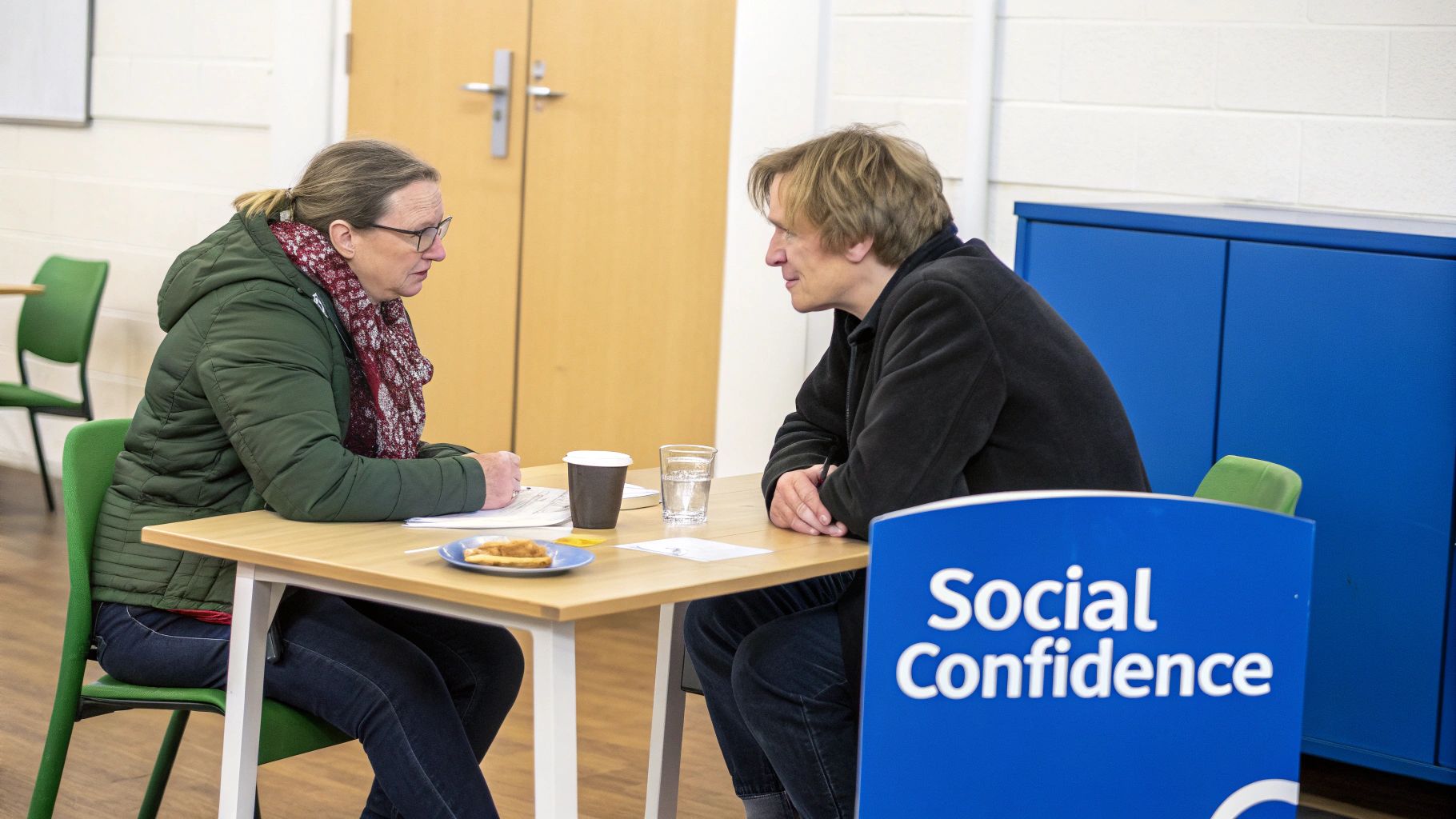
This method is a cornerstone of positive psychology and is widely used in corporate leadership training. The logic is simple: you gain more confidence when you operate from a position of strength. Instead of struggling to fix flaws, you invest energy where you are already primed for success.
How to Implement Strengths Identification
To turn this concept into a consistent confidence-building practice, use a structured approach. Merely thinking about your strengths is not enough; you must actively engage with them.
- Take Validated Assessments: Use tools like the Gallup CliftonStrengths or the free VIA Character Strengths Survey to get objective insights into your top talents.
- Ask for Feedback: Request specific, positive feedback from trusted colleagues or friends. Ask them, "When have you seen me at my best?" or "What do you see as my greatest strengths?"
- Analyze Past Successes: Reflect on your past achievements. What skills or personal qualities did you use to succeed? Look for recurring patterns that point to your core strengths.
- Create Strength-Based Goals: Set goals that require you to use your top strengths. If you excel at communication, volunteer to lead a team presentation.
By consciously building your life around what you do best, you create a foundation of authentic confidence that fundamentally changes how you see your potential.
5. Prime Your Mind for Success with Visualization
Visualization is a mental training exercise where you create detailed, positive mental images of yourself succeeding. This technique leverages the brain's inability to distinguish between vividly imagined scenarios and real experiences. By repeatedly rehearsing success in your mind, you build the neural pathways for confident behavior, essentially pre-programming yourself for a positive outcome.
This is a cornerstone of peak performance training for good reason. Olympic athletes visualize their perfect race. World-class musicians mentally rehearse complex pieces before stepping on stage. The goal is to build a mental blueprint of success so that when the real moment arrives, your mind and body already know how to act with confidence.
How to Implement Visualization
To make this exercise more than just daydreaming, a structured and sensory-rich approach is essential.
- Engage All Senses: Don't just "see" success. What do you hear, feel, and even smell? Imagine the firm handshake, the sound of applause, or the feeling of calm control in a high-pressure situation.
- Use a First-Person View: Experience the visualization from your own perspective, looking out through your own eyes. This makes the mental rehearsal feel more authentic.
- Feel the Emotions: As you visualize your success, actively connect with the emotions you would feel. Imagine the pride, relief, and joy of achieving your goal. This emotional connection solidifies the mental experience.
- Practice Consistently: Dedicate 5-10 minutes each day to this practice. The more frequently you rehearse success mentally, the more natural your confident responses will become.
By integrating this mental workout into your routine, you train your brain for success. This is one of the most effective confidence building exercises for adults because it builds competence from the inside out.
6. Build a Library of Wins with Achievement Journaling
Achievement journaling is a reflective practice designed to systematically build your confidence. This exercise involves regularly documenting your accomplishments, positive feedback, and progress toward goals. This creates a tangible record of your capabilities and directly counteracts the natural human tendency to focus on failures, retraining your brain to recognize and appreciate your successes.
This technique is a cornerstone of positive psychology and is widely used by executive coaches to help professionals overcome imposter syndrome. By creating an evidence-based log of your wins, you build an undeniable case for your own competence. The goal is to shift from a mindset of self-doubt to one of self-recognition.
How to Implement Achievement Journaling
To transform this from a simple diary into one of the most effective confidence building exercises for adults, a structured approach is essential.
- Be Specific and Detailed: Instead of writing "had a good day at work," document exactly what happened. For example, "I confidently led the team meeting and received positive feedback from my manager on the project proposal."
- Include Small Wins: Don't just focus on major milestones. Record small victories like "I finally organized my workspace," or "I stuck to my workout plan all week." These small wins accumulate to build significant momentum.
- Review Your Journal Regularly: The real power comes from reflection. Set aside time each week to read through your past entries. This is especially helpful before a challenging event, like a job interview.
- Incorporate Lessons Learned: Note not just the win, but what you learned. For instance, "I learned that preparing my notes beforehand significantly reduces my presentation anxiety."
By consistently documenting your progress, you create a personal reservoir of proof that you are capable and effective. This provides a concrete source of encouragement whenever self-doubt arises.
7. Master Social Situations with Role-Playing
Confidence in social settings isn't always innate; for many, it's a skill that must be developed through practice. Social skills practice and role-playing are powerful confidence building exercises for adults that involve rehearsing interactions in a low-stakes environment. This method systematically desensitizes you to social anxiety and equips you with the tools to handle real-world conversations with poise.
This structured approach is widely used in professional development. Organizations like Toastmasters International build public speaking confidence through repeated practice in a supportive group. Career coaches use mock interviews to prepare candidates to project competence under pressure. The objective is to build a "muscle memory" for social situations, making confident responses feel natural.
How to Implement Social Skills Practice
To gain the most from this exercise, you need a clear plan. Active participation is crucial for growth.
- Start with Low-Stakes Scenarios: Begin by role-playing simple interactions, like asking for directions or making a return at a store. Practice with a trusted friend.
- Focus on One Skill at a Time: Don't try to perfect everything at once. Dedicate one session to maintaining eye contact, another to asking open-ended questions, and a third to assertive communication.
- Record and Review: Use your phone to record your practice sessions. Watching yourself back provides invaluable, objective feedback on your body language and tone of voice.
- Seek Constructive Feedback: Ask your practice partner for specific, honest feedback. Ask them questions like, "Did I seem engaged?" or "Was my point clear?" to get actionable insights.
By creating a safe space to fail and refine your approach, you build resilient social confidence. Discover how developing these skills can increase confidence at work and open new career opportunities.
8. Command Respect with Body Language Training
Body language training is a confidence building exercise for adults that focuses on non-verbal communication. This practice acknowledges that how we carry ourselves physically not only shapes how others perceive us but also alters our own internal state. By consciously improving posture, eye contact, and vocal tone, you can project authority and self-assurance, which in turn boosts your actual feelings of confidence.
This method is a cornerstone of training for leaders, public speakers, and actors. Executive coaches use it to develop presence in the boardroom. Interview preparation courses teach it to help candidates exude competence. The goal is to align your external presentation with the confident person you want to become, creating a powerful feedback loop.
How to Implement Body Language Training
To make this exercise effective, focus on making small, consistent adjustments rather than attempting a complete overhaul at once.
- Practice Mindful Posture: Start by standing tall, pulling your shoulders back and down, and keeping your chin level. A strong posture instantly signals confidence.
- Master Eye Contact: Aim to hold eye contact for 4-5 seconds at a time during conversations. This shows you are engaged, trustworthy, and self-assured.
- Record Yourself: Use your phone to record yourself speaking or walking. Reviewing the footage provides invaluable, objective feedback on your posture, gestures, and vocal habits.
- Work on One Element at a Time: Don't try to fix everything at once. Focus on improving your posture for one week, then add in a focus on eye contact the next.
By consciously managing your non-verbal cues, you take control of the impression you make. Discover how to maintain good posture to build a foundation for a more confident presence.
Confidence Building Exercises Comparison Matrix
| Method | Implementation Complexity 🔄 | Resource Requirements ⚡ | Expected Outcomes 📊 | Ideal Use Cases 💡 | Key Advantages ⭐ |
|---|---|---|---|---|---|
| Positive Affirmations and Self-Talk | Low - Beginner | Minimal (time, no cost) | Increased self-confidence in weeks | Everyday confidence boosts, mental reframing | Easy, customizable, scientifically backed |
| Power Posing | Low - Beginner | None | Immediate physiological boost | Pre-performance, stress reduction | Quick results, no equipment needed |
| Comfort Zone Expansion Challenges | Moderate to High - Intermediate/Advanced | Time and emotional effort | Long-term confidence and resilience | Tackling anxiety, skill-building, adaptability | Builds real-world confidence, lasting effect |
| Strengths Identification and Development | Moderate - Intermediate | Strength assessments, feedback | Enhanced self-awareness and performance | Career development, personalized growth | Builds on strengths, evidence-based |
| Visualization and Mental Rehearsal | Moderate - Intermediate | Time, mental focus | Improved performance, reduced anxiety | Athletes, speakers, performers | Builds mental resilience and skill memory |
| Achievement Journaling | Low - Beginner | Time (daily 10-15 min) | Increased motivation and self-awareness | Personal growth, motivation maintenance | Tangible evidence of success, easy to do |
| Social Skills Practice and Role-Playing | Moderate - Intermediate | Practice partners, structured scenarios | Reduced social anxiety, improved communication | Social interaction, public speaking | Practical skill development, immediate feedback |
| Body Language and Presence Training | Moderate to High - Intermediate/Advanced | Consistent practice, feedback | Better non-verbal communication and self-image | Professional presence, leadership | Immediate visible results, influences perceptions |
Step into Your Power: The Foundation of Lasting Confidence
Building genuine, unshakable confidence is not a one-time event; it’s a daily practice. Throughout this guide, we've explored a powerful arsenal of confidence building exercises for adults, from rewiring your inner monologue to journaling your achievements. Each technique serves as a crucial building block in constructing a more self-assured version of yourself.
These exercises are designed to work in synergy. Visualizing success becomes more potent when you've identified your core strengths. Practicing social skills feels less daunting when you've grounded yourself with power poses. The journey is about creating a positive feedback loop where your internal mindset and your external actions constantly reinforce one another. You don't just think confidently; you begin to act confidently, and those actions fuel deeper self-belief.
Weaving the Threads: From Internal Work to External Presence
The key takeaway is that confidence is a holistic endeavor. It's built from the inside out and the outside in. While mental exercises form the critical internal framework, your physical presence is the tangible expression of that inner strength. How you carry yourself, your posture, and the way you occupy space are non-verbal signals that communicate your value to the world and, just as importantly, back to your own subconscious.
This connection between physical stature and psychological state is profound. Standing taller doesn't just change how others see you; it fundamentally alters how you see yourself. This is the principle behind what we call the 'Height Halo Effect'—the immediate boost in authority and presence that comes from improved posture and a subtle lift.
The Conzuri Difference: Your Physical Foundation for Confidence
At Conzuri, we believe that the tools for building confidence should be as sophisticated and discreet as the individuals using them. Unlike traditional brands that often sacrifice style for function, our footwear is designed for the modern world. We seamlessly integrate our proprietary Invisi-Boost™ technology into fashion-forward designs that complement your wardrobe, not compromise it.
By combining the mental and emotional confidence building exercises for adults outlined here with the physical foundation of a taller, more commanding posture, you create an unstoppable cycle of self-improvement. Your mind believes it, your body shows it, and the world reflects it back to you. This integrated approach is the secret to making your confidence not just a fleeting feeling, but a permanent state of being.
Ready to stand taller and feel the immediate shift in your presence? The mental exercises in this guide are your internal toolkit, and our shoes are the external foundation. Explore the Conzuri collection of height-boosting sneakers and boots to find the perfect pair that elevates your style and supercharges your journey to unshakable self-confidence.
Recent Articles


