


That dull, persistent ache in your lower back. The tight, nagging tension across your shoulders. Sound familiar? It’s the unwelcome signature of the modern professional, a constant reminder of hours spent hunched over a desk.
You know how quickly a comfortable chair can turn into a source of chronic pain, draining your focus, energy, and even your confidence. But what if you could finally sit up straight without it feeling like a workout? Imagine ending your workday feeling energized and aligned, not exhausted and sore.
This guide will skip the generic "sit up straight" advice. We’ll show you how to build a supportive workspace, integrate simple movements, and leverage a foundational secret—starting from your feet up—to make good posture feel completely effortless and natural.
Why Is Good Sitting Posture So Hard to Maintain?
It’s not entirely your fault. The modern workday is practically designed to make you slouch. The problem is a combination of poor habits and an environment that works against your body's natural alignment.
Most office chairs and desk setups are one-size-fits-all, which in reality, means one-size-fits-none. They can force your body into awkward, unnatural positions. Over time, your muscles adapt in the worst way.
- Core and back muscles that should hold you upright become weak and inactive.
- Chest and hip muscles that pull you forward become tight and shortened.
This creates a vicious cycle where slouching feels normal, and trying to sit with good posture feels like a constant struggle against your own body.
The Hidden Costs of a Sedentary Workday
This goes far beyond a little discomfort. According to a study published in the Journal of Public Health, prolonged sitting is linked to serious health problems. The research on office workers is even more direct: one study found that most employees sat for over 6 hours during an 8-hour shift, leading to alarming results:
- 53.5% experienced neck pain.
- 53.2% suffered from lower back pain.
- A staggering 73.6% reported feeling completely exhausted by the end of the day.
These aren't just statistics; they represent millions of people whose quality of life is being drained by their desk job. It proves that slouching isn't just a bad habit; it's a workplace epidemic. This is why actively learning how to maintain good posture is so critical for your long-term health and daily well-being. You can discover more about the effects of posture in our detailed guide.
Good posture is an active state, not a passive one. It requires conscious effort and the right foundational support to become second nature, turning slouching from a default habit into a thing of the past.
Ready to make a change? Let's dive in.
Build an Ergonomic Workspace That Supports You
You don’t need a thousand-dollar chair to fix your posture. An ergonomic workspace is simply one adjusted to your body. With a few smart tweaks, you can reduce strain and make sitting upright feel natural, not forced.
A great starting point is the "90-90-90 rule", an easy guideline for ideal joint alignment. The goal is to create a 90-degree angle at your ankles, knees, and hips.
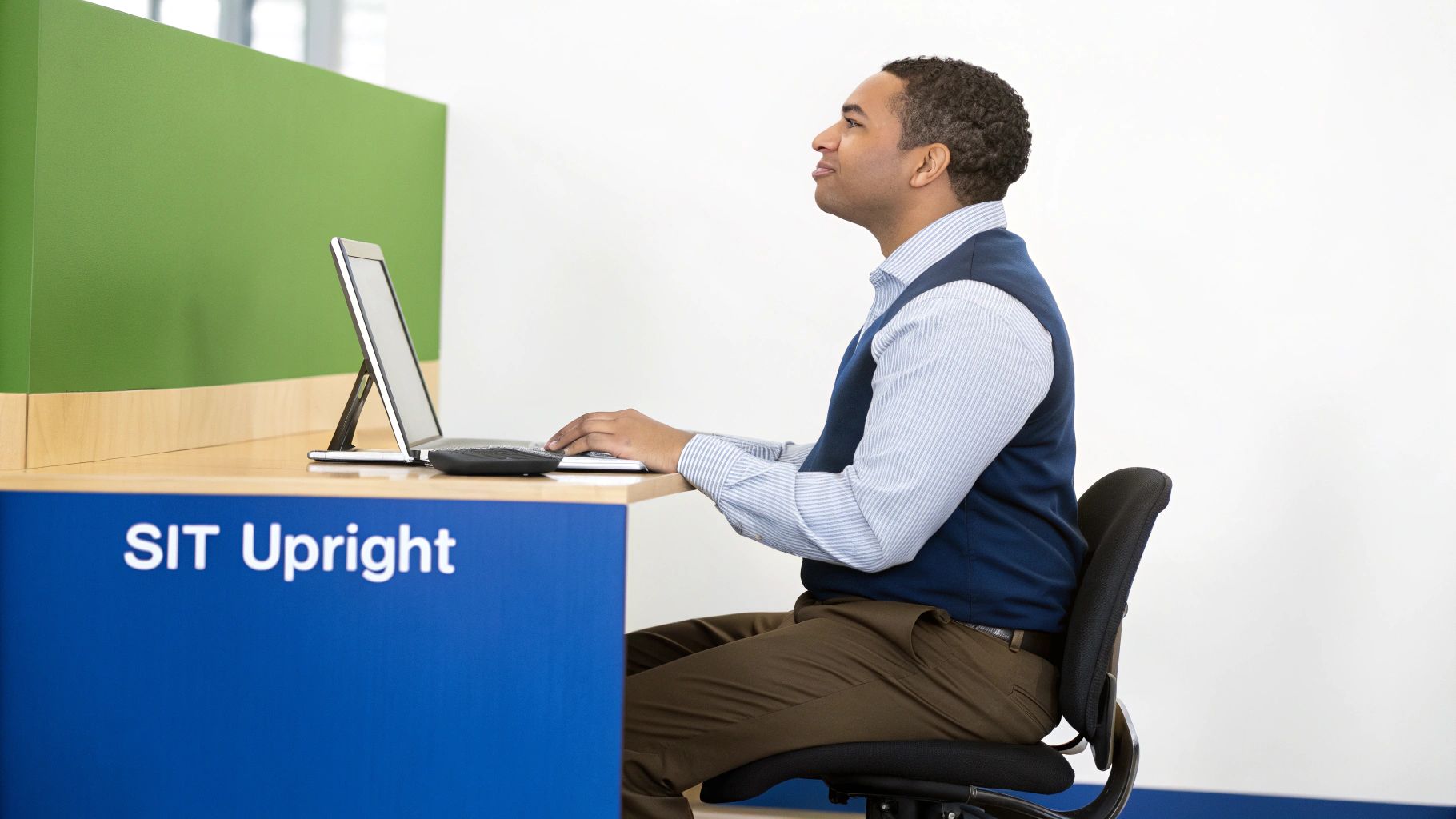
Your feet should be flat on the floor, thighs parallel to the ground, and your back fully supported. This simple setup minimizes the stress on your joints and spine.
- Chair too high? If your feet dangle, slide a footrest or a stack of sturdy books underneath them.
- Gap in your lower back? Roll up a towel and place it in the curve of your spine for instant lumbar support.
Align Your Desk for Instant Neck & Shoulder Relief
Your chair is just one piece of the puzzle. The position of your monitor and keyboard is just as crucial for preventing that nagging neck and shoulder pain.
Your monitor should be directly in front of you, about an arm's length away. The key is to position the top of the screen at or just slightly below your eye level. This prevents you from craning your neck up or down.
A truly ergonomic workspace also supports your visual health. To effectively prevent computer eye strain, ensure your monitor is positioned correctly and take regular screen breaks.
This quick visual breaks down exactly how to set up your desk for better posture.
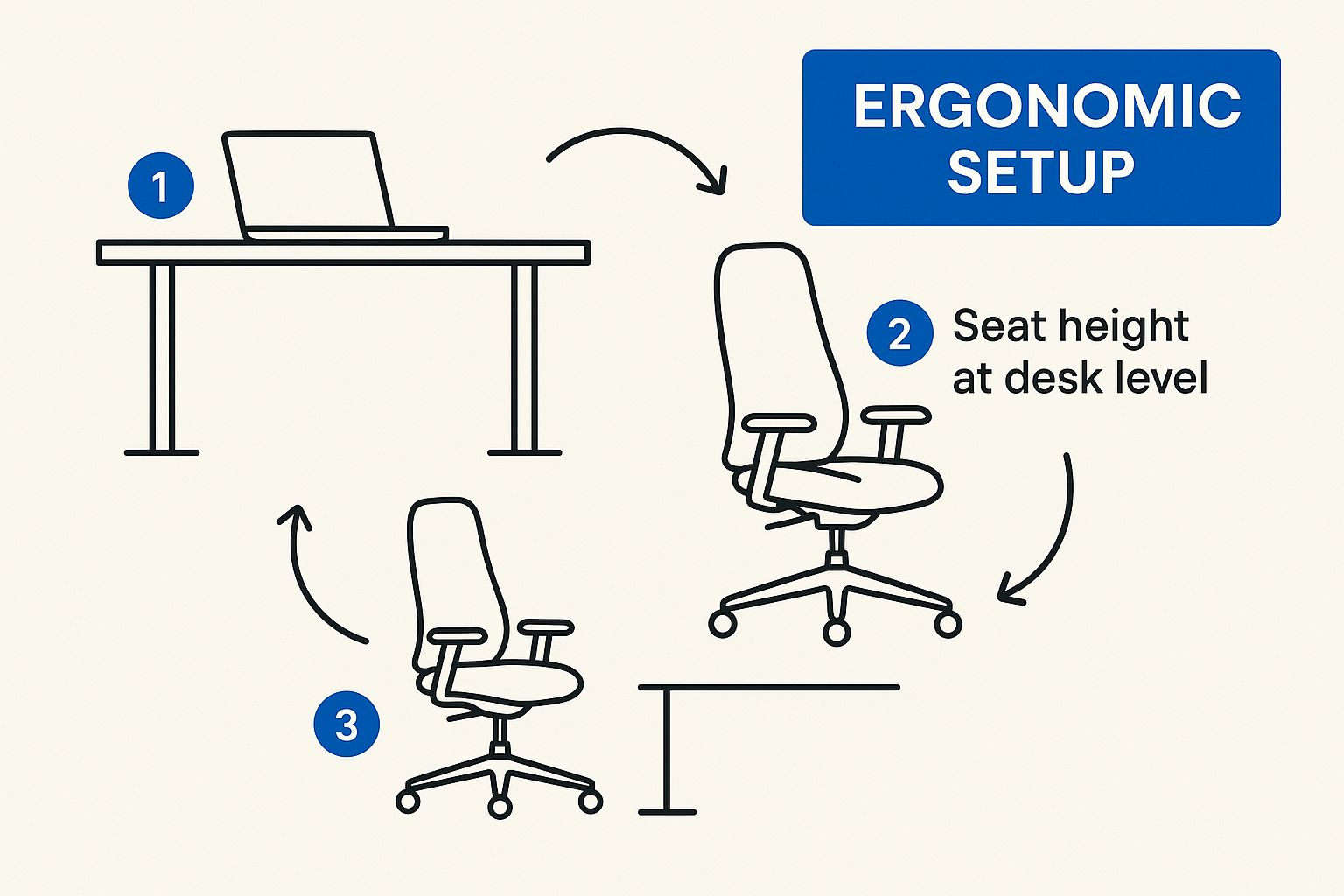
As you can see, small adjustments create a complete system where your body is naturally supported, not fighting against your desk all day.
This is more important than ever. In fact, one European workplace study revealed that a staggering 28% of workers sit almost all the time on the job, with many sitting for 3-4 hours continuously. That's why finding the best shoes for back support is so vital—proper footwear creates a stable foundation that supports your entire body, even when you're sitting down.
Your Ergonomic Workspace Checklist
Use this table to quickly audit your desk and make adjustments that will have an immediate impact on how you feel.
| Workspace Component | Ideal Setup for Good Posture |
|---|---|
| Chair Height | Feet flat on the floor, knees at a 90-degree angle. |
| Lumbar Support | Lower back is fully supported; use a cushion or towel if needed. |
| Monitor Position | Top of the screen is at or slightly below eye level. |
| Monitor Distance | About an arm's length away from your face. |
| Keyboard & Mouse | Wrists are straight, elbows close to your body at a 90-degree angle. |
| Footrest | Use if your feet don't comfortably reach the floor. |
Ticking off these boxes helps ensure every part of your setup is working for you, not against you.
Simple Movements to Counteract a Sedentary Day
Let’s be honest: your body wasn’t built to sit still for eight hours a day. It was designed to move. When locked in one position, your muscles fatigue from fighting gravity, leading to stiffness and that all-too-familiar desk slouch.
The secret to fighting back isn't an intense gym session. It's about breaking up the stillness with small, consistent movements.
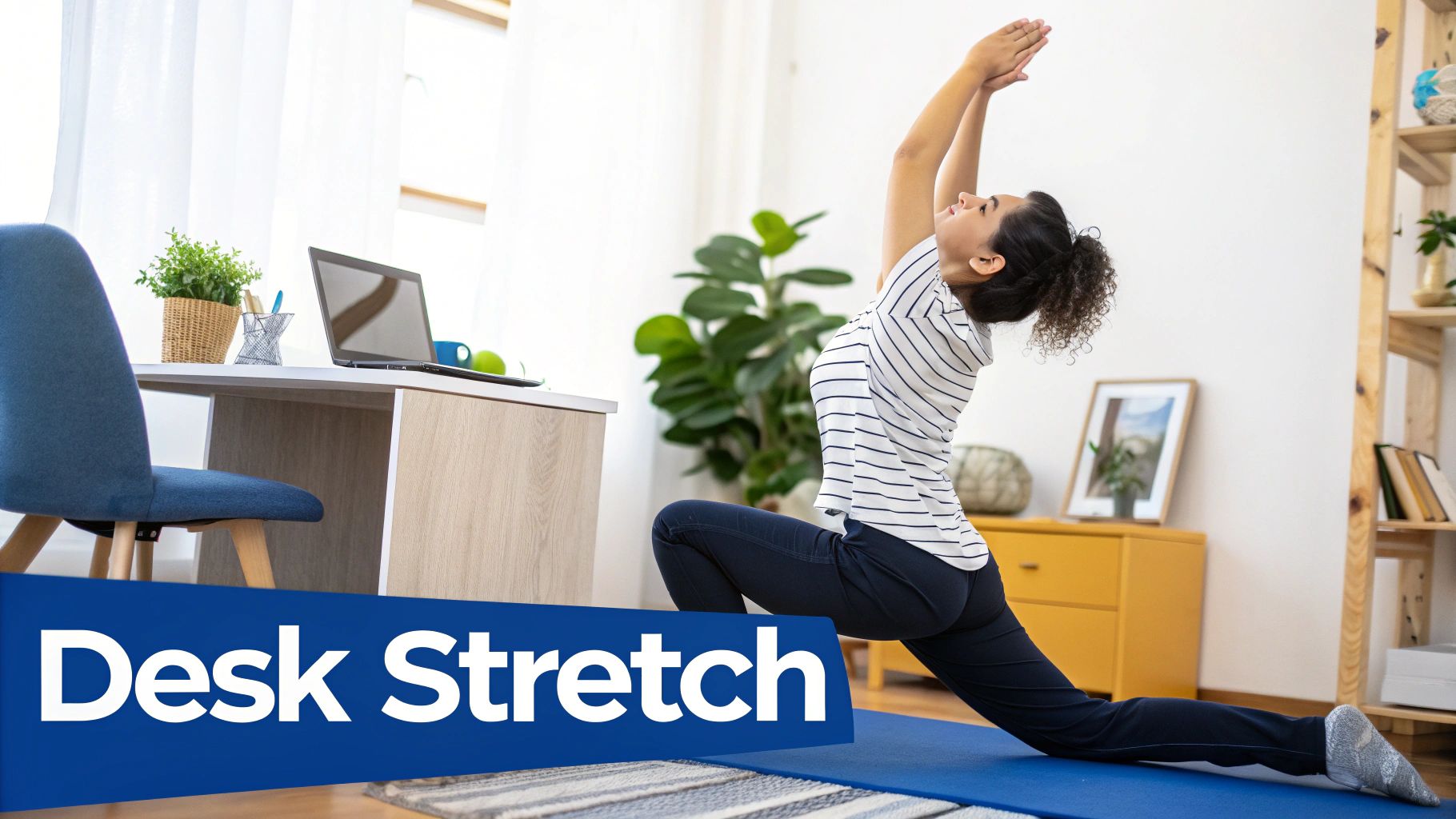
Think of these as "movement snacks." They take less than a minute, but they wake up dormant muscles, boost blood flow, and give your posture a much-needed reset. Sprinkling these into your routine can completely change how you feel by the end of the day.
Discreet Desk Stretches You Can Do Right Now
These quick movements are subtle enough that your coworkers won't even notice, but you'll feel the immediate relief.
- Gentle Neck Tilts: Let your right ear drop toward your right shoulder. Hold for 15-20 seconds to feel a light stretch along the left side of your neck. Repeat on the other side. This is perfect for easing tension from staring at your monitor.
- Shoulder Blade Squeezes: Sit up tall. Imagine you're trying to pinch a pencil between your shoulder blades. Squeeze them together for 10 seconds, then release. Do this 5-10 times to activate the muscles that naturally pull your shoulders back.
- Seated Spinal Twist: Sit at the edge of your chair with your feet flat on the floor. Gently twist your torso to the right, using your chair's backrest for light leverage. Hold for 20 seconds, breathe deeply, and switch to the left. This is a great way to loosen up a stiff spine.
The goal here is gentle, consistent movement. These micro-breaks are about reminding your body to get out of that fixed position. It’s a huge part of learning how to improve posture while sitting for good.
These small movements do more than ease physical tension; they rebuild your mind-body connection. The more you do them, the more you’ll notice when you start to slump, reinforcing the strong, upright alignment you’re working on.
This awareness is a powerful tool that builds better habits at your desk and even translates into learning how to walk with confidence.
How Your Feet Secretly Control Your Sitting Posture
It sounds counterintuitive, but good sitting posture doesn't start with your back—it starts with your feet. Your body is a single, connected unit known as the kinetic chain. Whatever happens at the bottom has a direct ripple effect all the way up. Your feet are the literal foundation of this entire structure.
When your feet aren't properly supported, the problems travel. A slight misalignment can cause ankles to roll inward, which throws your knees out of position. This subtle shift then tilts your pelvis, undermining the base of your spine before you've even thought about sitting up straight.
With a shaky foundation, maintaining good posture feels like a constant fight against gravity. It doesn't matter how ergonomic your chair is; a weak base will always sabotage your best efforts.
The Ground-Up Solution for Effortless Alignment
This is where supportive footwear becomes crucial, even when you're sitting. Shoes with well-structured insoles create a stable and aligned foundation for your whole body. This helps keep your pelvis neutral, allowing your spine to stack naturally as it's meant to.
This issue is amplified by modern work life. A staggering 80% of U.S. jobs are primarily sedentary, yet less than half of Americans use ergonomic setups. You can see the official numbers on these workplace trends from BLS.gov.
Conzuri elevator shoes are built with this ground-up principle in mind. They do more than add height—their engineered insoles deliver the crucial stability your body needs for better alignment. Unlike some traditional brands, Conzuri integrates this support into modern, stylish designs. This is why having the best walking shoes with arch support can make a world of difference far beyond just standing or walking.
When your feet are properly supported, sitting upright becomes less of a conscious chore and more of a natural default. It’s all about building that solid foundation.
Ultimately, when you stabilize your base, you set your entire body up for success.
Mindful Habits & Smart Tools for Lasting Posture
Fixing your posture isn't an overnight project. It’s a long game that requires building smart habits and using the right tools. Forcing yourself to sit straight is a battle you’ll lose to muscle fatigue every time. Instead, build a system where good posture becomes your natural default.
One simple but effective strategy is the Pomodoro Technique. Work in focused 25-minute sprints, then take a five-minute break to get up, stretch, and walk around. This rhythm interrupts long, static sitting periods, stopping muscle stiffness before it starts.
Strengthen Your Core: Your Body's Natural Brace
Think of your core muscles as your body's internal support frame. A strong core gives your spine the stability it needs to stay upright without you even thinking about it. When those muscles are weak, your skeleton and smaller back muscles are forced to pick up the slack—a job they weren't designed for. That's where pain and slouching begin.
True posture improvement comes from within. Tools like ergonomic chairs help, but a strong, engaged core provides the natural, dynamic support your body needs to maintain alignment effortlessly.
You don't need to live at the gym. Weaving simple core exercises into your routine—even for a few minutes a day—builds the endurance needed for a healthy posture.
Smart Tools That Reinforce Good Alignment
While building core strength is the long-term goal, the right gear can provide immediate relief and reinforcement.
- Lumbar Pillows: These are fantastic for filling the gap between your lower back and the chair, providing crucial support to the natural curve of your spine.
- Ergonomic Chairs: A good one can be a game-changer, but they're often pricey. You can get similar benefits by making smart adjustments to your current chair.
- Supportive Footwear: Never underestimate the power of your shoes. Your feet are your foundation. Conzuri’s footwear is designed to create a stable base, helping align your entire body from the ground up. This foundational support is a key piece of the puzzle, much like how a specialized what is a shoe lift works to correct imbalances. When your base is solid, sitting upright feels more natural and requires less effort.
Your Questions on Sitting Posture Answered
Even with the best plan, questions will come up. Improving your posture is a process, so it’s normal to wonder about timelines, tools, and tricky situations.
Let's clear up some of the most common questions.
How long does it take to fix years of bad posture?
There’s no magic number, but you can feel immediate relief by making smart ergonomic tweaks. As for retraining your muscles, expect a journey of a few weeks to several months of consistent effort.
The key is consistency. Small, daily adjustments and simple exercises will get you there much faster than a massive, once-a-week effort. Soon, sitting upright will feel natural, not like a chore.
Is a standing desk the ultimate solution?
A standing desk is a fantastic tool for breaking up long periods of sitting, but it's not a silver bullet. You can still stand with terrible posture—slouching over your keyboard, locking your knees, or leaning all your weight onto one hip.
That just trades one set of problems for another.
The real win comes from variety. The ideal setup is alternating between sitting in a supportive chair and standing with good alignment. That’s how you keep your spine happy and your muscles engaged.
Are expensive ergonomic chairs really worth it?
If you deal with chronic pain or sit for most of your day, a high-end ergonomic chair can be a worthwhile investment. The level of customization offers targeted support that's tough to replicate with pillows and hacks.
But for most people, it's not a must-have. You can create a very supportive setup with a standard office chair by applying the principles we've discussed. A good lumbar pillow and ensuring your feet are planted firmly on the floor (or a footrest) can make a huge difference without breaking the bank.
Can I improve my posture while driving?
Absolutely. The same rules of alignment apply behind the wheel.
Adjust your seat so your knees are level with or slightly below your hips. Sit all the way back so your spine rests against the seatback.
If there's a gap behind your lower back, tuck a small lumbar cushion there for support. Finally, adjust the steering wheel so your arms have a slight, relaxed bend. This stops you from reaching forward and rounding your shoulders—a classic driving mistake.
At Conzuri, we believe confidence starts from the ground up. Our height-boosting shoes are engineered with supportive insoles that create a stable foundation, making it easier to maintain proper alignment whether you’re sitting at your desk, standing tall in a meeting, or walking into a room with newfound assurance.
Recent Articles


