


Ever felt a disconnect in a conversation? You're hearing "yes," but every other signal is screaming "no." That gut feeling is your brain decoding the most honest language we speak: body language. It's the unspoken dialogue of gestures, posture, and expressions that reveals the truth long before words do.
Struggling to make a strong first impression or feel truly heard? You're not alone. The secret isn't just what you say, but how you show it. This guide will show you how to master this silent language, helping you project unshakeable confidence and build genuine connections. Get ready to decode the signals you're sending and receiving.
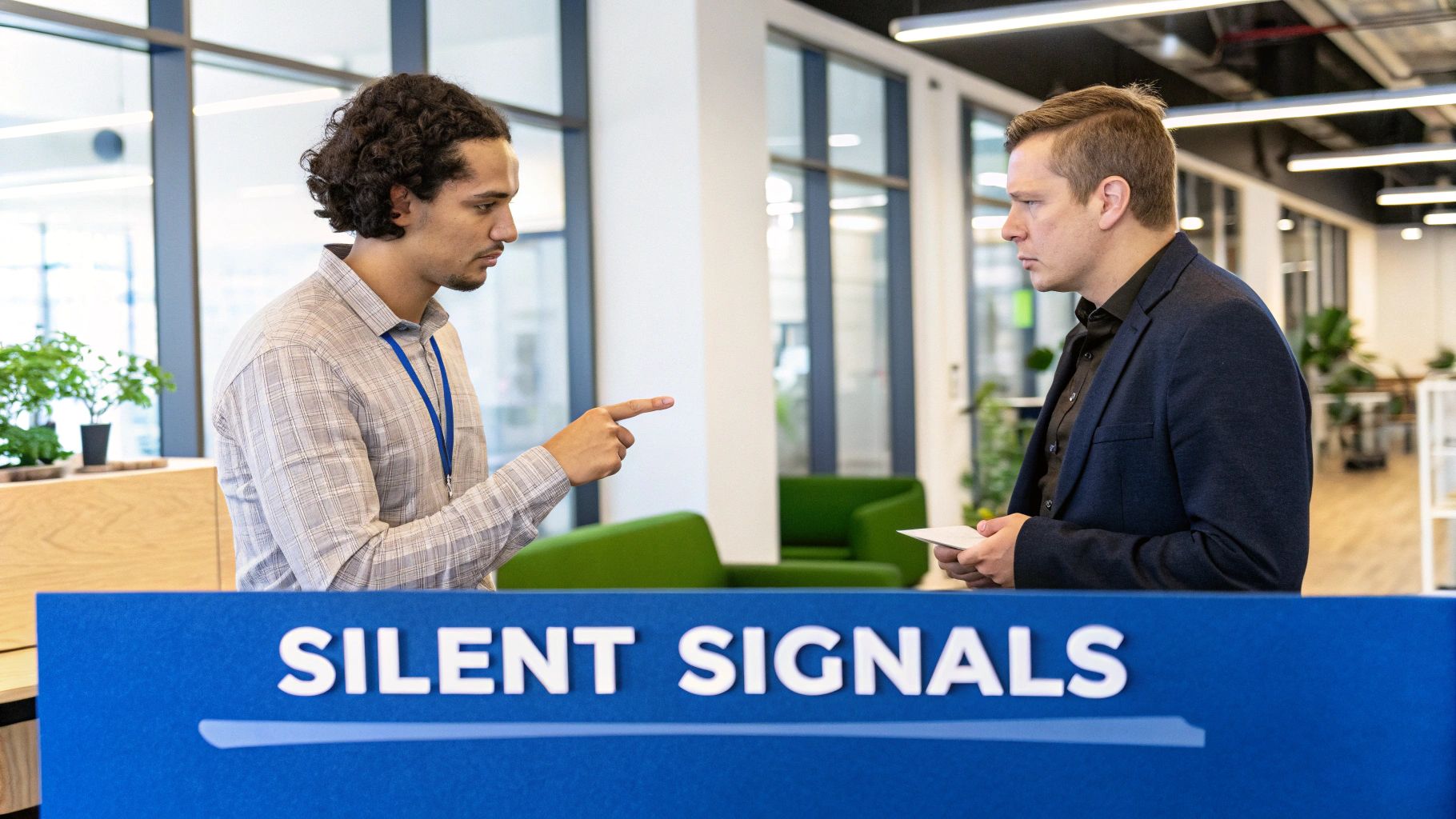
The Silent Conversation We All Speak
Have you ever walked into a room and just felt the tension? No one said a word, but you knew something was off. That's your brain processing thousands of nonverbal cues—the subtle signals people broadcast constantly. This is the very essence of body language in communication.
It’s more than random twitches. It’s a constant, powerful stream of information. It includes how you stand, the direction of your feet, and the micro-expressions that flash across a face in seconds. This unspoken dialogue builds trust, shapes perceptions, and quietly dictates the outcome of everything from a job interview to a first date.
The True Impact of Nonverbal Signals
Many believe communication is all about choosing the right words. But groundbreaking research from psychologist Albert Mehrabian in the 1960s tells a different story. His work completely changed our understanding of how we convey feelings and attitudes.
Mehrabian’s model breaks down a message's impact into three channels. What he found was astonishing.
The Three Channels of Communication
| Communication Channel | Percentage of Impact | Examples |
|---|---|---|
| Body Language | 55% | Posture, gestures, facial expressions, eye contact |
| Tone of Voice | 38% | Pitch, volume, speed, intonation |
| Spoken Words | 7% | The actual vocabulary and sentences used |
The big takeaway? When your words clash with your body language, people always believe what your body is saying. Think of it this way:
- Words are the script: They deliver the basic information.
- Tone of voice is the delivery: It adds the emotional flavor.
- Body language is the performance: It reveals the true feeling and intent.
This simple truth is the first step toward becoming a more perceptive and effective communicator. You can learn more about these influential body language statistics and what they mean today.
Why Your Unspoken Words Matter So Much
Mastering your nonverbal signals isn’t about being manipulative. It's about authenticity. It’s about ensuring your physical presence aligns with your confidence, intentions, and expertise.
When you become aware of the nonverbal messages you send and receive, you gain the ability to build stronger connections, navigate social situations with ease, and project genuine self-assurance.
It’s a powerful feedback loop. Adopting a confident posture doesn't just change how others see you; it changes how you feel about yourself. Small tweaks—like standing taller or holding eye contact—can trigger a genuine boost in your confidence. Your inner state and outer expression reinforce each other, helping you show up as your best self.
Why Your Nonverbal Cues Matter More Than You Think
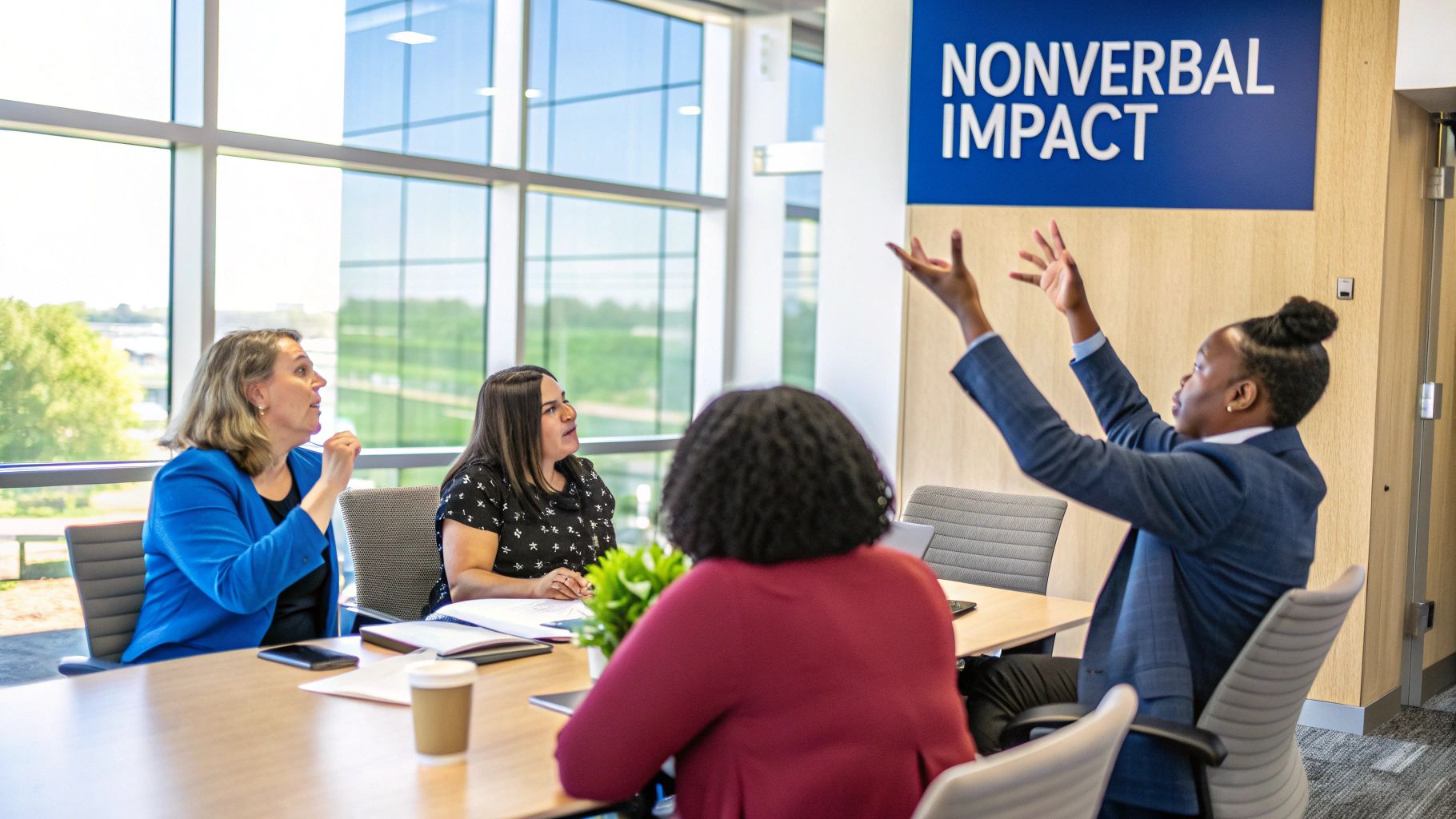
Long before you say a word, your body is talking. In the first few seconds of meeting someone, their brain makes thousands of snap judgments. These are based on nothing but your physical presence. It’s a primal process that decides if you’re trustworthy, confident, and competent.
This is where understanding body language becomes a massive advantage. It’s not just about not crossing your arms. It's about consciously shaping the silent story you tell about yourself. The right nonverbal signals can open doors, build instant rapport, and establish your authority before you even introduce yourself.
Building Trust and Credibility Instantly
Trust is the bedrock of any relationship. While you can choose your words carefully, your body language often feels more honest. It's a direct line to your true feelings. When your physical signals match what you're saying, you project undeniable integrity.
Think about it. If a salesperson praises a product while fidgeting and avoiding your gaze, you doubt them. But if they stand with an open posture, maintain steady eye contact, and use relaxed gestures, their words land with authority. You believe them.
Here’s how nonverbal cues build trust:
- Open Gestures: Uncrossed arms and visible hands are a universal sign of honesty. You're subconsciously telling others, "I have nothing to hide."
- Steady Eye Contact: Holding a comfortable gaze shows you're engaged, confident, and sincere. It's a nonverbal handshake.
- Confident Posture: Standing tall with your shoulders back doesn't just look good. It projects self-assurance and reliability.
These signals are the foundation of a killer first impression. They make you seem more approachable and persuasive right from the start.
The Language of Leadership and Influence
In a boardroom or negotiation, body language is everything. Leaders who command respect have mastered this silent language. Their presence alone can calm a tense room or rally a team.
For instance, a leader who stands at the head of a table with an expansive posture is nonverbally claiming authority. On the other hand, someone who hunches over signals submission and a lack of belief in their own words.
Your posture doesn't just communicate to others; it communicates to yourself. Adopting a powerful stance can genuinely increase feelings of confidence and reduce stress, giving you a tangible edge.
This link between posture and mindset is real. To improve your presence, it's critical to learn how to maintain good posture—not just for your health, but for the powerful psychological boost it delivers.
When Your Signals Get Crossed
Nothing creates confusion faster than misaligned body language. Imagine telling your team you're "excited" while slumping in your chair with a deadpan expression. Your words say one thing, but your body screams boredom or doubt.
This disconnect kills your message. When faced with mixed signals, people will almost always believe the nonverbal cue.
Making sure your body language is in sync with your intentions is key. When you master these signals, your message isn't just heard—it's felt and believed.
Decoding Common Body Language Signals
Becoming fluent in body language is like seeing the conversation beneath the conversation. You stop just hearing words and start seeing the real story—the emotions, the confidence, the truths. This skill fundamentally changes how you navigate the world.
Let’s break down the most common signals. Think of this as your field guide to the silent language everyone is speaking. Once you know what to look for, you can’t unsee it.
The infographic below shows how much weight we put on key gestures. It’s a powerful reminder of how simple, positive signals can shape perception.
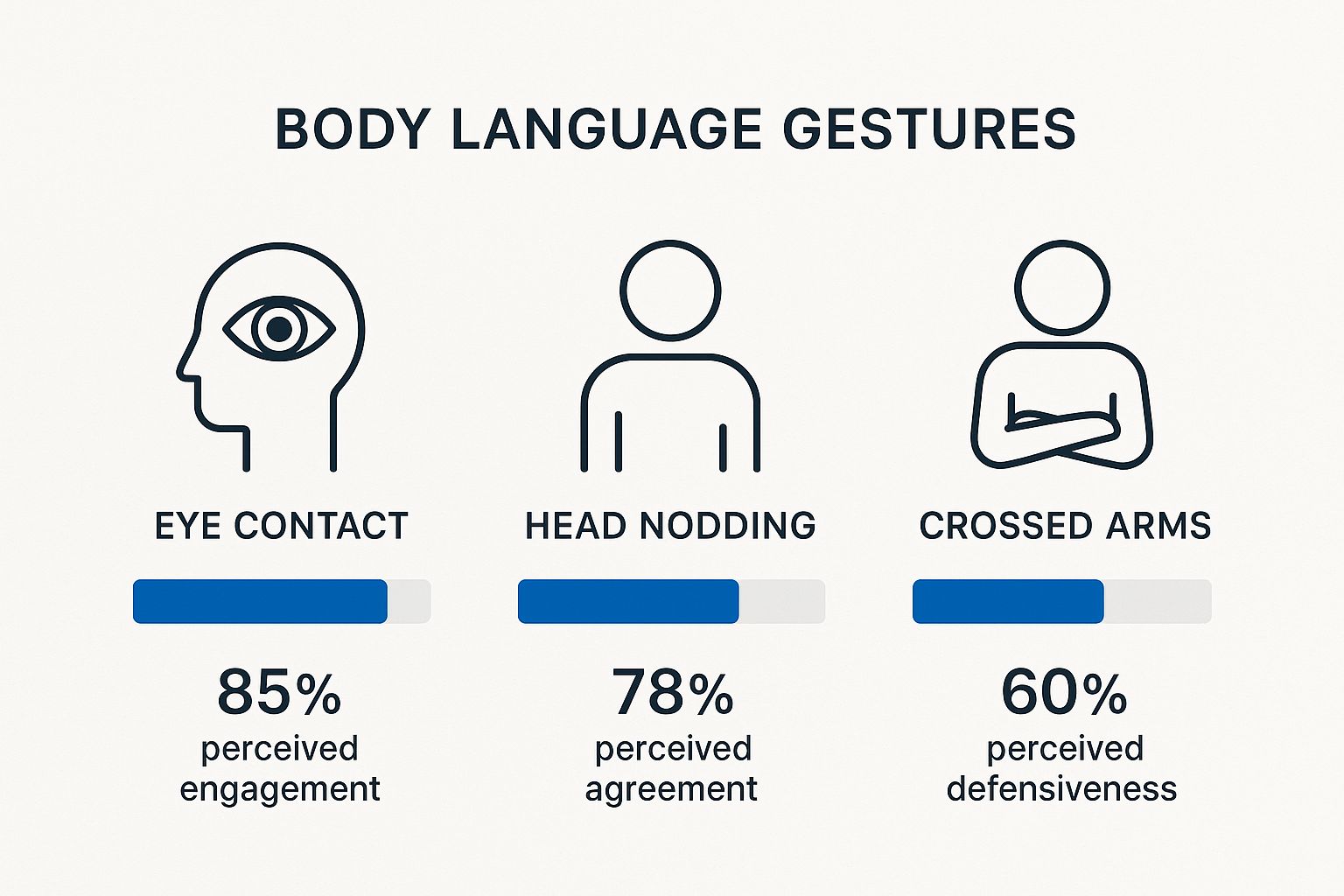
The data doesn't lie. Open signals like making eye contact and nodding are seen as signs of trust. On the flip side, closed gestures like crossing your arms instantly put up a defensive wall.
The Face: The Window to the Soul
The human face is an emotional billboard. It's capable of thousands of expressions in a split second. Understanding these signals is ground zero for reading people accurately.
-
Eye Contact: This is your most powerful nonverbal tool. Steady, relaxed eye contact shows you’re confident, honest, and engaged. Darting eyes can signal nervousness, while avoiding eye contact can seem dishonest or disinterested.
-
Smiling: A real smile—one that crinkles the eyes (the "Duchenne smile")—is a universal sign of warmth. A forced, tight-lipped smile? That’s usually a mask for discomfort.
-
Micro-expressions: These lightning-fast expressions leak out before we can stop them. They last just a fraction of a second. They’re tiny, unfiltered glimpses into how someone truly feels.
Posture and Presence: How You Carry Yourself
Your posture introduces you before you speak. It broadcasts your confidence, energy, and attitude. A strong, upright posture doesn't just look better; it actually makes you feel more powerful.
Think of your posture as your personal billboard. Standing tall with your shoulders back and head held high projects confidence and competence. Slouching, on the other hand, can make you appear insecure or less energetic.
This is non-negotiable in moments that matter. Mastering your posture is one of the quickest ways to start overcoming public speaking anxiety and own the room.
- Open vs. Closed Posture: An open posture means your torso is exposed—arms uncrossed, ready to engage. This signals confidence and a willingness to connect. A closed posture, like crossing your arms, creates a literal barrier that reads as defensive or resistant.
Gestures and Hand Movements
Your hands are the punctuation marks of your body language. They add emphasis, illustrate ideas, and often betray your inner state.
-
Illustrators: These gestures paint a picture, like holding your hands apart to show size.
-
Emblems: These have a direct verbal meaning, like a thumbs-up or the "OK" sign.
-
Manipulators: This is a fancy term for fidgeting—tapping fingers, rubbing hands, or playing with hair. These self-soothing behaviors spike when someone is nervous, stressed, or uncomfortable.
Positive vs Negative Body Language Signals
Here’s a quick-reference table to help you spot the difference between signals that invite connection and those that put up walls.
| Body Part | Positive/Open Signal | Negative/Closed Signal |
|---|---|---|
| Eyes | Steady, relaxed eye contact | Darting eyes, avoiding contact |
| Face | Genuine smiles, relaxed muscles | Frowning, tight jaw, pursed lips |
| Arms | Arms uncrossed, gestures open | Arms crossed over chest or stomach |
| Hands | Purposeful gestures, palms visible | Fidgeting, clenched fists, hiding hands |
| Legs | Legs uncrossed, planted firmly | Legs crossed tightly, bouncing foot |
| Posture | Standing tall, shoulders back | Slouching, hunched shoulders |
This table isn't about judging people. It's about understanding the unspoken messages they might be sending. It gives you a roadmap for interpreting the vibe in the room.
Proxemics: The Use of Personal Space
Proxemics is about how we use physical space. The distance you keep from others sends a powerful, unspoken message about your relationship.
Generally, we operate in four distinct zones:
- Intimate Distance (0-18 inches): Reserved for people we’re closest to.
- Personal Distance (1.5-4 feet): The sweet spot for friends and casual chats.
- Social Distance (4-12 feet): The standard for business meetings and formal interactions.
- Public Distance (12+ feet): Used for public speaking.
Getting these zones wrong can make people feel uncomfortable. Stand too close to a coworker, and you might seem invasive. Stand too far from a friend, and you could seem distant. Respecting these boundaries is essential for making people feel at ease.
Reading The Room and Avoiding Misinterpretation
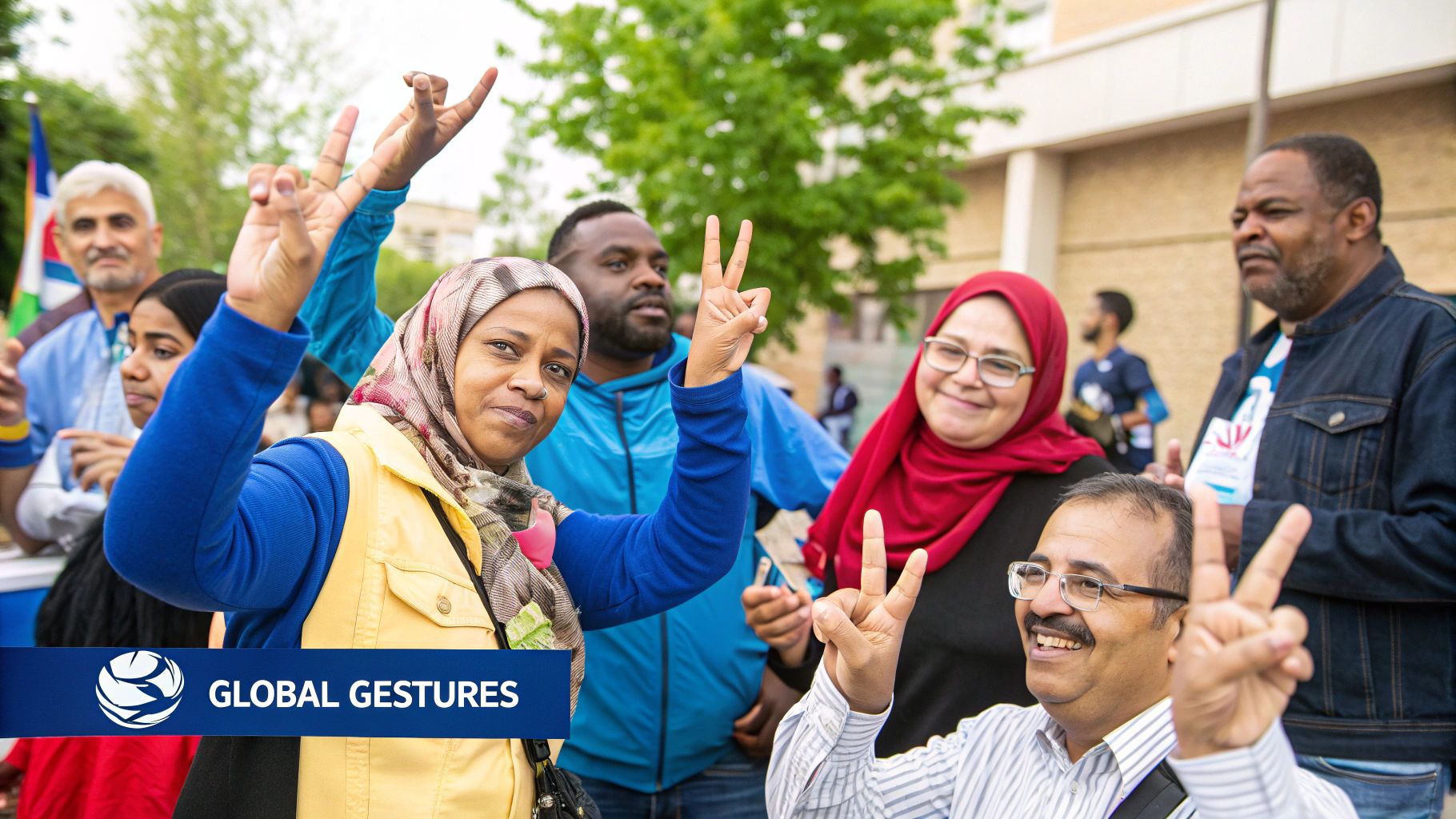
Learning to spot individual gestures is one thing. But truly understanding body language goes deeper. A single cue rarely tells the whole story.
If you want to read people accurately, you must move past a simple "dictionary" approach. Crossed arms don't always mean someone is defensive. You have to interpret human behavior like an expert.
It’s about seeing the bigger picture. Is your coworker avoiding eye contact because they’re lying, or are they just shy? Is that person crossing their arms because they hate your idea, or is the room just cold? Get it wrong, and you’re headed for an awkward misunderstanding.
Context Is Everything
Here's the most important rule: context is king. The meaning of a gesture can flip entirely based on the situation, people, and culture. Without context, you’re just guessing.
Before you jump to a conclusion, ask yourself:
- What’s the environment like? A cold room makes anyone cross their arms. A noisy bar forces people to lean in close.
- What’s our relationship? You don’t interact with your boss the same way you do with a close friend.
- What’s their normal? Some people are naturally fidgety. Others are stoic. The real tell isn't a single behavior, but a change from their usual baseline.
The Power of Signal Clusters
Stop focusing on one-off gestures. Instead, look for "clusters"—groups of nonverbal signals that happen together. These paint a much clearer picture. It’s the difference between finding one puzzle piece and seeing the whole corner.
Think about it this way: a colleague says they love your proposal, but you notice a few other things.
- They say "yes" while giving a tiny headshake.
- Their arms are folded tightly across their chest.
- Their feet are pointing toward the door.
Taken together, that cluster tells a different story. Their words say one thing, but their body screams resistance and a desire to escape. That’s your cue to dig deeper.
Learning to spot these patterns gives you a massive advantage. It’s a core skill when it comes to learning how to increase confidence at work, helping you navigate tricky situations with more insight.
Navigating Cultural Differences
This one is huge. What’s friendly in one culture can be deeply offensive in another. In a connected world, knowing the difference is essential for building respect.
A gesture's meaning is not universal. Here are a few examples:
- The "Thumbs-Up": In the U.S., it's a sign of approval. But in parts of West Asia and South America, it's a serious insult.
- Eye Contact: In North America, direct eye contact signals honesty. In many Asian cultures, holding a gaze can feel aggressive.
- Personal Space: People from Latin American cultures often stand closer when they talk. Do that in Northern Europe, and you might make someone very uncomfortable.
If you ignore these differences, you're setting yourself up for failure. The key is to enter any cross-cultural situation with humility. Watch, listen, and adapt.
How To Project Confidence And Build Rapport
Knowing how to read a room is one thing. The real power comes when you turn that lens on yourself.
You can consciously shape the nonverbal signals you send to build trust, project unshakeable confidence, and create genuine rapport in minutes.
The goal isn't to fake it. It’s about making small, authentic tweaks so your body tells the same story as your words. Whether you're in a job interview, on a first date, or leading a meeting, mastering your own body language is a game-changer.
Master the Fundamentals of a Confident Presence
Before you get advanced, you must nail the basics. These foundational moves create an immediate positive impression. Small shifts here make a world of difference.
Here are the three pillars of a confident presence:
- Maintain an Upright Posture: Stand tall. Sit tall. Pull your shoulders back and open your chest. This doesn't just send a message of self-assurance; it makes you feel more powerful.
- Offer a Firm Handshake: A handshake is often the first physical impression you make. A firm grip paired with solid eye contact signals trustworthiness and respect.
- Use Expansive Gestures: Stop trying to make yourself small. Take up space. Use open, natural hand gestures to add weight to your points. It shows you're comfortable and engaged.
The Art of Mirroring for Instant Connection
Ever notice how you pick up the mannerisms of a friend during a deep conversation? That's a subconscious process called mirroring, and it's a powerful tool for building rapport.
It’s all about subtly reflecting another person's body language.
When done right, mirroring sends a powerful unconscious signal: "I get you. We're on the same page." It creates an almost instant feeling of connection.
The key here is subtlety. Don't be a copycat who mimics every move—that just comes off as weird. The goal is to match the overall vibe and energy.
If they lean in, you lean in a bit. If they have a relaxed posture, you adopt a similar one. This simple technique builds a bridge of trust without a single word.
Actionable Strategies for High-Stakes Moments
Your ability to project confidence is never more important than during presentations or interviews. When you’re under pressure, body language can make or break you. This is where practical strategies for public speaking confidence become essential.
Before your next big meeting, try "power poses." Research shows standing in an expansive pose for just two minutes can boost confidence and slash stress. Stand with your feet apart, hands on your hips, and chin held high. It’s a simple trick to prime your mind and body for success.
This internal boost helps you walk into the room with genuine confidence.
And don't forget, your appearance is a huge piece of the nonverbal puzzle. Knowing how to dress for success works hand-in-hand with confident body language, creating a cohesive and powerful impression.
Your Top Questions About Body Language, Answered
Alright, we've unpacked the fundamentals, but you probably have some burning questions. Let's get into the specifics—the real-world stuff that comes up when you start paying closer attention to this silent language.
Think of this as your go-to guide for those nagging "what if" and "how do I" questions.
So, Can You Really Tell if Someone Is Lying?
This is the big one. While fidgeting or breaking eye contact are often linked to lying, here's the hard truth: no single sign is a dead giveaway. Those same behaviors could just mean someone is nervous or shy.
Spotting deception isn't about finding a single "tell." It’s about noticing clusters of signals that don't match the words being spoken. More importantly, you must compare those signals to how the person normally acts—what experts call their baseline. Relying on one cue is a rookie mistake.
How Can I Improve My Body Language for Virtual Meetings?
On a video call, your body language is all that's visible inside that little frame. This makes every signal even more important. It's a focused performance.
- Sit Up Straight: This is non-negotiable. It instantly projects confidence and shows you're engaged.
- Look at the Camera: This is the virtual equivalent of eye contact. Look directly into the lens when you speak.
- Use Your Hands: Don't hide your hands. Use natural gestures within the camera's view to add emphasis and energy.
- Show You're Listening: A simple nod or a smile is gold. It tells the speaker you're locked in.
Also, good lighting goes a long way. It makes you look more professional and adds to a positive presence.
Is Body Language the Same Everywhere?
Absolutely not. A few basic facial expressions—like a smile for happiness—are pretty universal. However, many common gestures mean wildly different things across cultures.
A friendly gesture in one country can be a massive insult in another. The classic 'thumbs-up' sign is positive in the US. In parts of West Asia, though? It's deeply offensive.
Always consider the cultural context. Getting this wrong can lead to serious misunderstandings. Getting it right helps you build much stronger connections with people from different backgrounds.
What’s the Difference Between Body Language and Micro-Expressions?
Think of body language as the big picture—all the conscious and unconscious movements you make. Micro-expressions, on the other hand, are a specific subset. They're tiny, involuntary facial expressions that flash across a face for just a fraction of a second.
They often betray a person's true, hidden emotion. You can consciously decide to sit up straight, but micro-expressions are almost impossible to fake. That's what makes them such powerful, unfiltered clues to what someone is really feeling.
If you have more questions about our products or how they work, you can explore our Frequently Asked Questions page for more details.
Ready to elevate your presence and project unshakable confidence? Conzuri designs height-boosting footwear that gives you a discreet lift without sacrificing style. Unlike traditional brands that often look bulky, Conzuri designs modern silhouettes that blend seamlessly into any wardrobe. Discover our full collection of confidence-boosting shoes today and step into a more powerful version of yourself.
Recent Articles


