


Staring at your closet, wondering what shoes to wear for a job interview? You’ve perfected your resume and rehearsed your answers, but the final piece of the puzzle—your footwear—can make or break that critical first impression. Skimp on this detail, and you risk signaling carelessness before you even say hello. But choose the right pair, and you walk in with an unshakable confidence that interviewers can feel.
This guide will show you exactly how to select the perfect job interview shoes. We'll decode confusing dress codes, highlight the timeless styles that always work, and reveal how modern footwear can give you a psychological edge. Get ready to find the pair that helps you stand tall—literally and figuratively—and turn a great first impression into a job offer.
Why Your Shoes are a Critical First Step to Interview Success
Let's be real—the moments before a big interview are buzzing with nervous energy. You’ve prepped your answers, ironed your shirt, and printed your resume. But have you thought about what your shoes are communicating? They’re more than just the last thing you put on; they set the entire tone for your professional presence.
Your choice of footwear is a powerful, unspoken signal. It screams attention to detail, respect for the opportunity, and a quiet confidence that you belong in that room. On the flip side, a scuffed, worn-out, or wildly inappropriate pair can subtly chip away at your credibility before you even shake hands.
A study by the University of Kansas found that people can accurately judge 90% of a stranger's personality from their shoes alone, including traits like conscientiousness. Your footwear is quite literally the foundation you stand on when you walk in, and it says a lot about you before you ever say a word.
Speaking of standing tall, understanding how elevator shoes work can be a game-changer for posture and presence. Unlike traditional brands such as Chamaripa, Conzuri designs modern silhouettes that blend a discreet height-boost seamlessly into the shoe, improving your posture without being noticeable. It's a subtle tweak that can make a major difference in how you carry yourself.
Of course, shoes are just one piece of the puzzle. For a comprehensive guide on how to prepare for a job interview that covers everything else, you'll want to make sure you're fully buttoned up. So, let's get you ready to find the right pair of shoes—the kind that helps turn that first impression into a firm handshake and, ultimately, a job offer.
How to Decode the Modern Workplace Dress Code for Any Interview
Figuring out what to wear to a job interview can feel like cracking a secret code. What flies at a laid-back tech startup would get you some serious side-eye at a conservative law firm. Getting it right matters, and your shoes are a dead giveaway that you understand the company's culture before you even say a word.
This is where doing a little homework pays off big time. Hop on the company's website and check out their "About Us" page. Look at the team photos. Are they in sharp suits and power-heels, or are they rocking smart sweaters and chinos? That's your first major clue for matching your footwear to their vibe.
This image breaks down the hierarchy of professional shoes, making it easy to pick the right style.
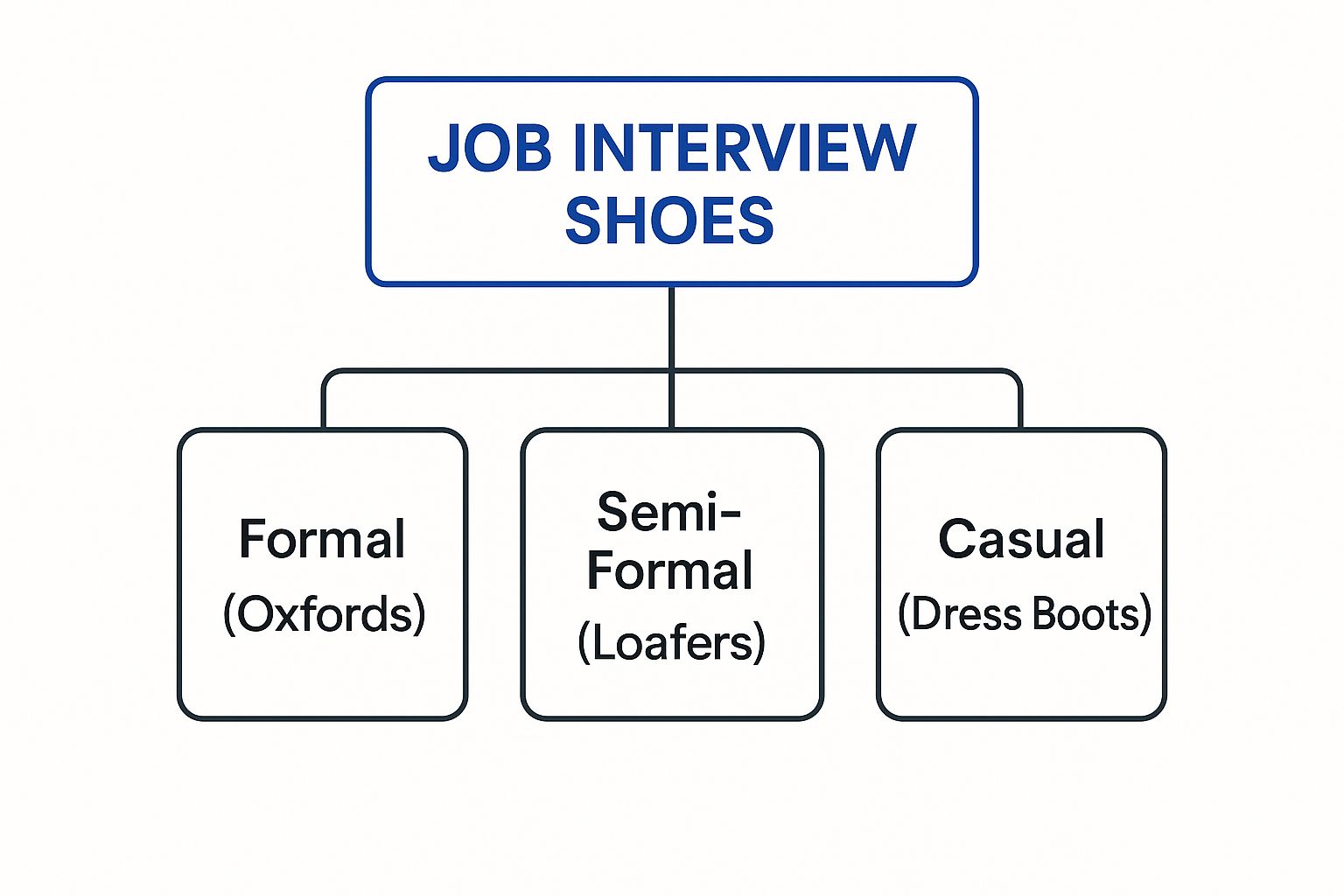
As you can see, Oxfords sit at the top of the formality pyramid. Loafers offer a ton of versatility for those in-between "business casual" scenarios, and dress boots nail the relaxed-yet-professional look for more modern offices.
Matching Shoes to the Dress Code: A Simple Breakdown
Let's get practical. Here are the most common dress codes you'll run into and the perfect shoes to pair with them. Nailing this detail shows you're professional, respectful, and serious about the opportunity.
-
Corporate/Formal Business: This is the big league—think law, finance, and top-tier consulting. The expectation is traditional and polished, period. For men, classic leather Oxfords or Derbys in black or a deep, rich brown are non-negotiable. Their clean, structured look screams authority and attention to detail.
-
Business Casual: Welcome to the most common—and most confusing—dress code out there. This is the world of tech companies, marketing agencies, and most modern corporate offices. You've got more room to play here. Leather loafers, sleek Derbys, or even a pair of high-quality Chelsea boots are all solid choices. If you want to explore this style more, our guide on https://www.conzuri.com/blogs/news/the-ultimate-guide-to-brown-formal-shoes-for-men has some great options that fit right in.
-
Smart Casual: This is the uniform for creative industries and startups. It’s all about blending professionalism with a bit of personality. Your shoes should be clean and stylish, but not stuffy. Think minimalist leather sneakers (but they must be spotless), desert boots, or a pair of refined loafers.
To make things even clearer, here's a quick cheat sheet.
Interview Shoe Guide by Industry Dress Code
This table gives you a quick rundown of what works where, helping you match the right shoes to the right environment without overthinking it.
| Dress Code | Men's Recommended Shoes | Women's Recommended Shoes | Key Characteristics |
|---|---|---|---|
| Formal Business | Oxfords, Derbys (Black, Dark Brown) | Closed-Toe Pumps, Classic Flats | Polished leather, conservative, structured |
| Business Casual | Loafers, Chelsea Boots, Brogues | Loafers, Ankle Boots, Elegant Flats | Versatile, high-quality materials, stylish |
| Smart Casual | Minimalist Sneakers, Desert Boots | Stylish Flats, Fashionable Loafers | Clean, modern, shows personality |
Remember, getting comfortable with these nuances helps beyond just the interview. For a broader look at professional footwear, it's worth exploring guides on business casual footwear. The goal is always to look intentional and put-together—it proves you’re ready to step confidently into whatever role comes your way.
The Best Job Interview Shoes for Men to Command Respect
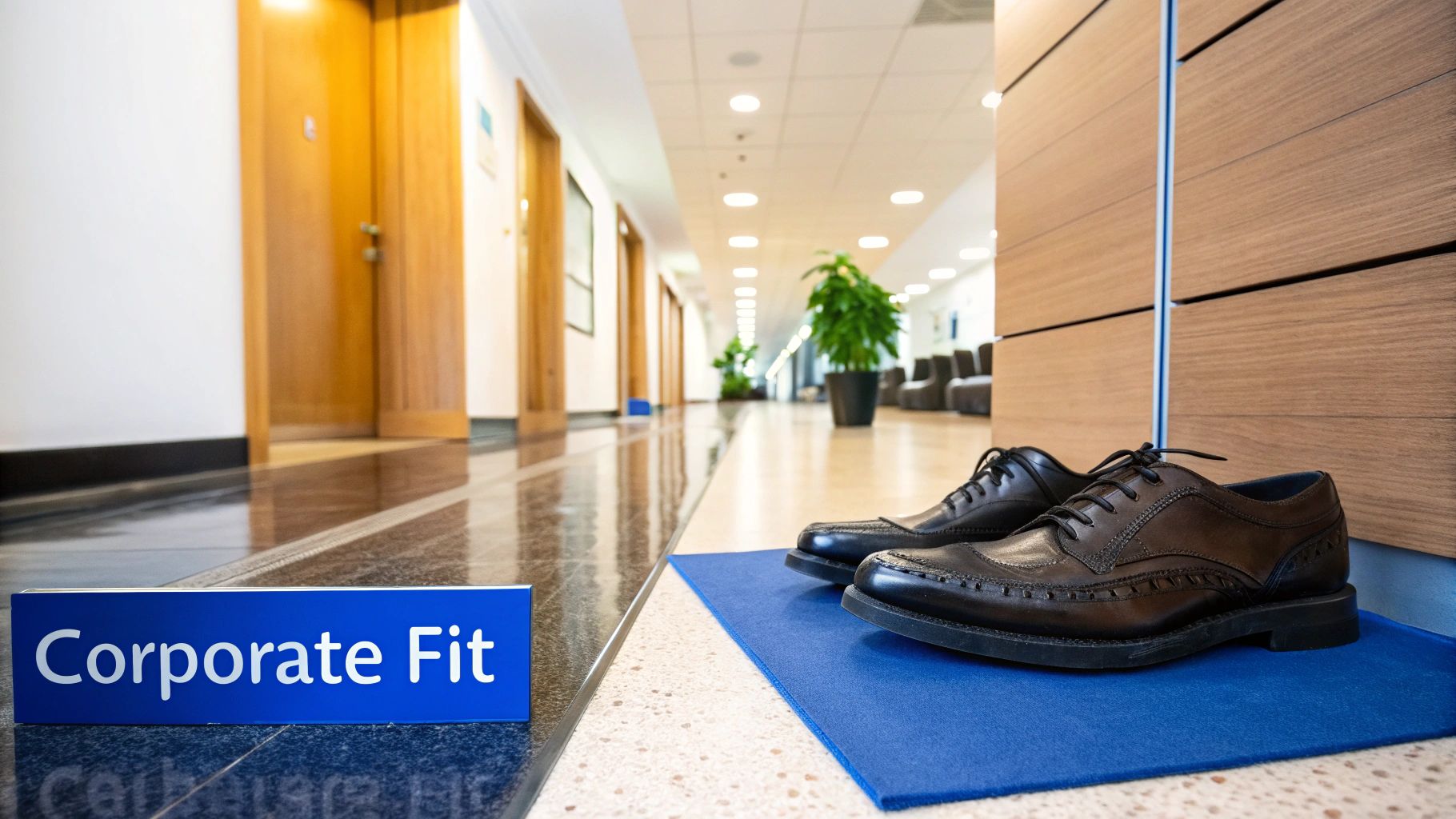
When it comes to dressing for an interview, your shoes are the anchor. They're the one detail that can either pull your entire look together or completely sink it. Before you even say a word, the right pair of shoes communicates professionalism, confidence, and a sharp eye for detail.
Classic leather dress shoes are, without a doubt, the gold standard. They’re timeless, respected, and the perfect finishing touch. But not all dress shoes are made equal, and knowing the subtle differences is what separates the guys who get it from those who don't.
The Only 3 Styles You Need to Know for Any Interview
Figuring out men’s dress shoes is actually simpler than it looks. You really only need to know three core styles to handle just about any interview situation, from corporate law to a tech startup.
- Oxfords: This is your quintessential dress shoe. Defined by its sleek "closed lacing" system (where the eyelet tabs are stitched under the vamp), the Oxford is the most formal and polished option you can choose. It's the no-brainer for interviews in finance, law, or any top-tier corporate setting.
- Derbys: A little more relaxed than the Oxford, the Derby has an "open lacing" system (where the eyelet tabs are stitched on top of the vamp). This makes it incredibly versatile. It looks just as sharp with a suit as it does with smart chinos, making it the perfect go-to for most business casual interviews.
- Loafers: The most modern and laid-back of the big three. A well-made leather loafer projects an effortless, confident vibe. It's an excellent choice for interviews in creative fields, tech, or any company with a smart casual dress code.
Why Color and Condition Are Non-Negotiable
Let’s keep it simple: stick to the classics. Black is the most formal color, full stop. It should be your default for any conservative industry. Dark brown offers a bit more personality and pairs beautifully with navy and grey suits. For more casual interviews, you’ve got a few more options—our guide to the top black business casual shoes for men breaks it down.
But here’s the most important rule of all: the condition of your shoes matters more than anything. A scuffed, dirty, or worn-out pair will kill your credibility, no matter how expensive your suit is. Make sure they are clean, polished, and in great shape.
Finally, think about the subtle edge that modern shoe design can give you. Unlike old-school brands, Conzuri integrates a discreet height-increasing lift into classic designs. This isn't just about being taller—it's about improving your posture and projecting a natural sense of authority the moment you walk in. It’s that hidden feature that helps you stand a little straighter and feel more confident, ready to own the room.
The Best Job Interview Shoes for Women for a Polished Impression
Let's be honest, picking out your interview shoes is more than just a final touch—it can make or break your confidence. You want footwear that says "I'm prepared and professional," not "I can't wait to take these off." The goal is to find a pair that feels so right, you forget you're even wearing them. That way, you can put all your energy into crushing the interview.
For almost any corporate or business casual interview, closed-toe shoes are the undisputed champion. It’s a small detail that signals you’re serious and you understand the unspoken rules of a professional environment.
Top 3 Styles That Always Work for an Interview
Think of these as your go-to options. They're timeless, polished, and work across a ton of different industries. The key is to match the shoe to the company's vibe and, just as importantly, to what your feet can handle.
- Classic Pumps: A pump with a low-to-mid heel (think less than three inches) is the gold standard for a reason. It’s a power move. They instantly sharpen your posture and give your whole outfit a sleek, commanding silhouette.
- Elegant Flats: If you're going to be on your feet for an office tour or just hate heels, a great pair of flats is a lifesaver. Look for a pointed or almond-toe style in leather or suede—it keeps the look sophisticated, not casual.
- Sophisticated Loafers: This is the modern classic. A structured loafer bridges the gap perfectly between comfort and chic. They’re fantastic for business casual settings and send a message that you're confident and on-trend.
The number one rule? You have to be comfortable. An interview day can be a marathon. If you’re fidgeting, wincing, or walking awkwardly, that’s what the interviewer will remember—not your brilliant answers.
Choosing the Right Color and Material to Complete Your Look
Color is your secret weapon for pulling your entire look together. Neutral tones are always a winning strategy. You want your shoes to complement your outfit, not compete with it.
Stick to these fail-safe colors:
- Black
- Navy
- Nude or beige
- Charcoal gray
These shades are the definition of versatile and work with everything from a power suit to a tailored dress. For materials, you can't go wrong with polished leather or a high-quality suede.
And one last thing—make sure they are spotless. Scuff-free, polished, and in perfect condition. It’s a tiny detail that says more about your professionalism and attention to detail than you’d think.
Why Comfort and Confidence Go Hand in Hand for Interview Success
Let’s be real. An uncomfortable pair of shoes can absolutely wreck an otherwise perfect interview. If you’re distracted by pinching leather or a wobbly heel, it shows. Your focus drifts, your body language gets shifty, and your confidence takes a nosedive.
Comfort isn't just a nice-to-have; it's a strategic advantage. When your feet hurt, you fidget. You shift your weight. You might even break eye contact without realizing it—all tiny signals that can read as nervousness or a lack of self-assurance. Finding genuinely comfortable shoes is mission-critical, and our ultimate guide to comfortable dress shoes for work is a great place to start.
The demand for footwear that actually feels good is skyrocketing. The global work shoes market is even expected to hit USD 714.9 million by 2035, proving that professionals are done with sacrificing comfort for style. (You can read more on this trend here).
The Psychology of Posture and Presence
Your shoes do more than just cover your feet—they're the foundation of your entire posture. Standing tall with your shoulders back doesn't just look better; it projects authority and self-assurance, something every interviewer picks up on instantly.
This is where modern footwear engineering gives you an edge.
A subtle, integrated lift doesn’t just add height; it mechanically encourages you to stand straighter, engage your core, and open up your posture. This creates a more assertive and self-assured physical presence.
Unlike old-school dress shoes, Conzuri’s designs build this height-boosting tech right in, seamlessly. The result is a more powerful stance that helps you feel—and appear—more in command from the moment you walk through the door.
To really get into the science behind it, check out The Ultimate Guide to Elevator Shoes. At the end of the day, choosing the right job interview shoes is an investment in your own confidence, built from the ground up.
Answering Your Top Questions About Interview Shoes
When you're pulling together the perfect interview outfit, a few last-minute questions always seem to pop up about the shoes. Let’s clear up the confusion so you can walk in feeling 100% confident, not second-guessing your choices.
Here are the answers to the questions we hear most often.
Are sneakers ever acceptable for a job interview?
Honestly? Almost never. In 99% of professional settings, traditional athletic sneakers are an absolute no-go.
The one exception might be an interview at a super-casual tech startup or a creative agency. Even then, you’d need a pair of pristine, minimalist leather sneakers that look brand-new. They have to look intentional and polished, not like you just came from the gym.
When in doubt, don't risk it. Always opt for a more formal shoe. If you want a modern feel that sits somewhere in the middle, Conzuri’s height-boosting sneakers offer that sharp, refined silhouette that bridges the gap between casual and professional.
Should my shoes and belt match?
For men, this is a classic style rule for a reason: it works. Matching your leather shoes to your leather belt—black with black, brown with brown—is a small detail that makes a big impact. It instantly pulls your entire look together and signals that you're sharp and pay attention to the details.
It might not be a dealbreaker in every industry, but it’s such an easy way to elevate your presentation. Why wouldn't you?
What are the biggest shoe mistakes to avoid at an interview?
It all comes down to the details. The most damaging mistakes are the ones that suggest you don't care. Walking in with scuffed, dirty, or worn-out shoes is a major red flag. You should also steer clear of anything too casual or distracting, like open-toed shoes, stilettos, or flashy designs.
But the absolute biggest mistake? Choosing style over comfort. If your shoes are pinching your feet and you’re visibly uncomfortable, it completely undermines your confidence. You need to be able to stand and walk with ease.
This is especially true for new shoes. Always wear them around the house for a few days first. Learning how to break in new dress shoes is non-negotiable if you want to be comfortable and focused on the big day.
Ready to walk into your next interview with unshakable confidence? At Conzuri, we design footwear that combines timeless style with a discreet height boost, improving your posture and presence from the ground up.
Explore the full Conzuri collection and find your perfect pair today.
Recent Articles


