


Ever watched someone walk into a room and instantly command attention? Before they’ve even said a word, their presence speaks volumes. You feel their self-assurance. What if that person could be you?
The reality is, a huge part of how you're perceived hinges on your body language—not your words. Small physical tweaks like standing taller, holding eye contact, and using intentional gestures can instantly shift how others see you. More importantly, it changes how you see yourself.
This isn't about becoming someone you're not. It's about learning the practical skills to let your inner competence shine through. Ready to build unshakeable confidence from the outside in? Let’s get started.
Mastering Your Nonverbal Confidence Cues
Confidence is often felt before it's heard. It's a vibe. And that vibe is built on a foundation of unspoken signals you're sending out every second.
Think about it: your posture, the way you hold eye contact, even what you do with your hands—it all tells a story about your level of self-assurance. And it’s a bigger deal than you might think. Seminal research by Dr. Albert Mehrabian found that body language can account for as much as 55% of your communication's impact.
This isn't just theory. A well-known 2010 study by social psychologist Amy Cuddy found that when people held "power poses"—think expansive, open postures—for just two minutes, they not only felt more powerful but also experienced a measurable drop in cortisol (the stress hormone).
Your body can actually lead your mind.
Projecting Confidence Through Your Stance
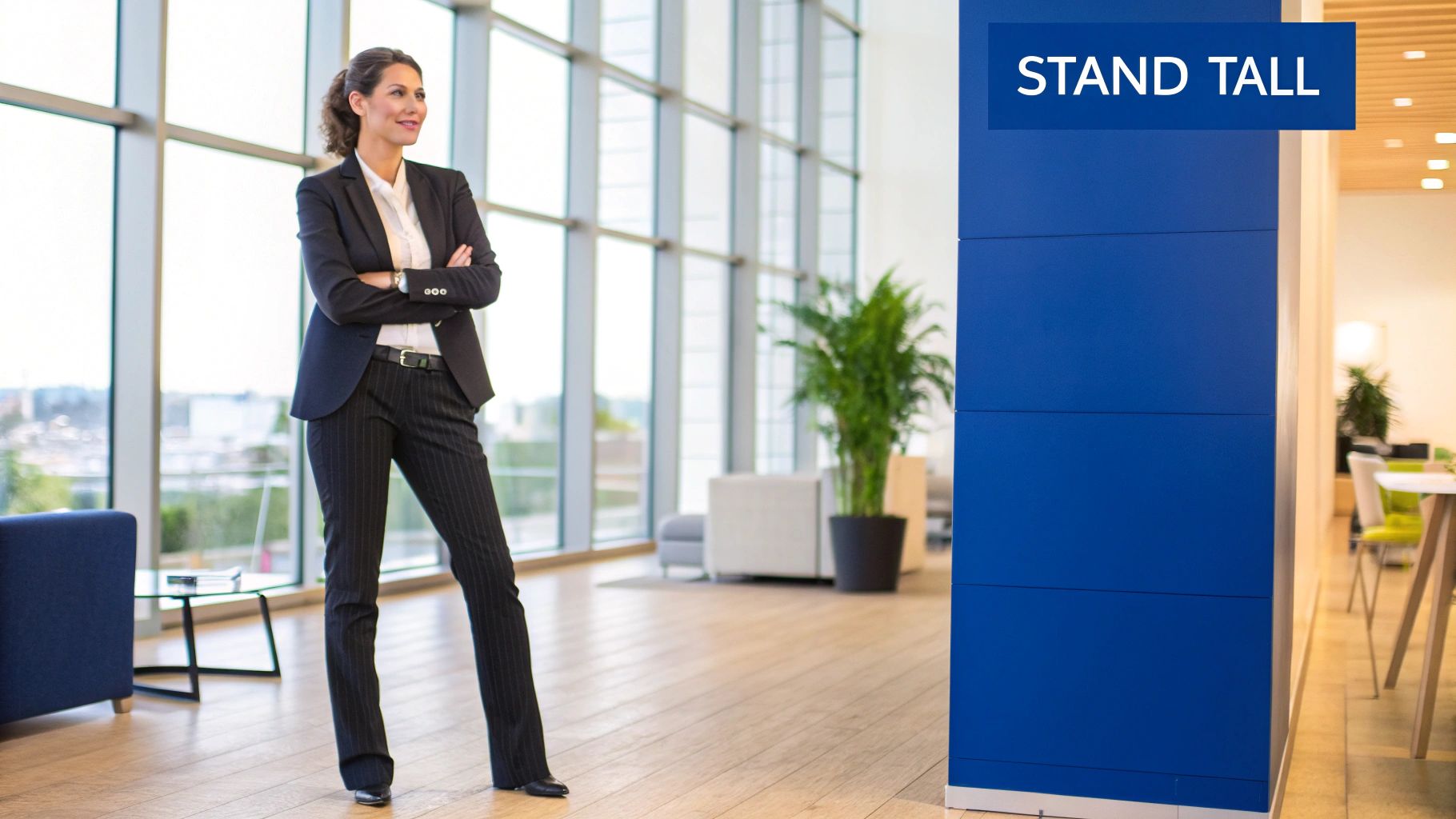
Your posture is ground zero for confident body language. Slouching or hunching your shoulders is a dead giveaway for insecurity, making you look like you're trying to shrink. On the flip side, an open, upright stance tells everyone you're comfortable, present, and in control.
Here’s how to lock it in:
- Plant your feet shoulder-width apart. This gives you a stable, grounded base that looks and feels solid.
- Pull your shoulders back and let them drop. Tension in your neck and upper back makes you look anxious. Relax them.
- Keep your head level. Your chin should be parallel to the floor, which naturally sets you up for direct eye contact.
This isn't just about "faking it." It’s about building a physical framework that supports a confident mindset.
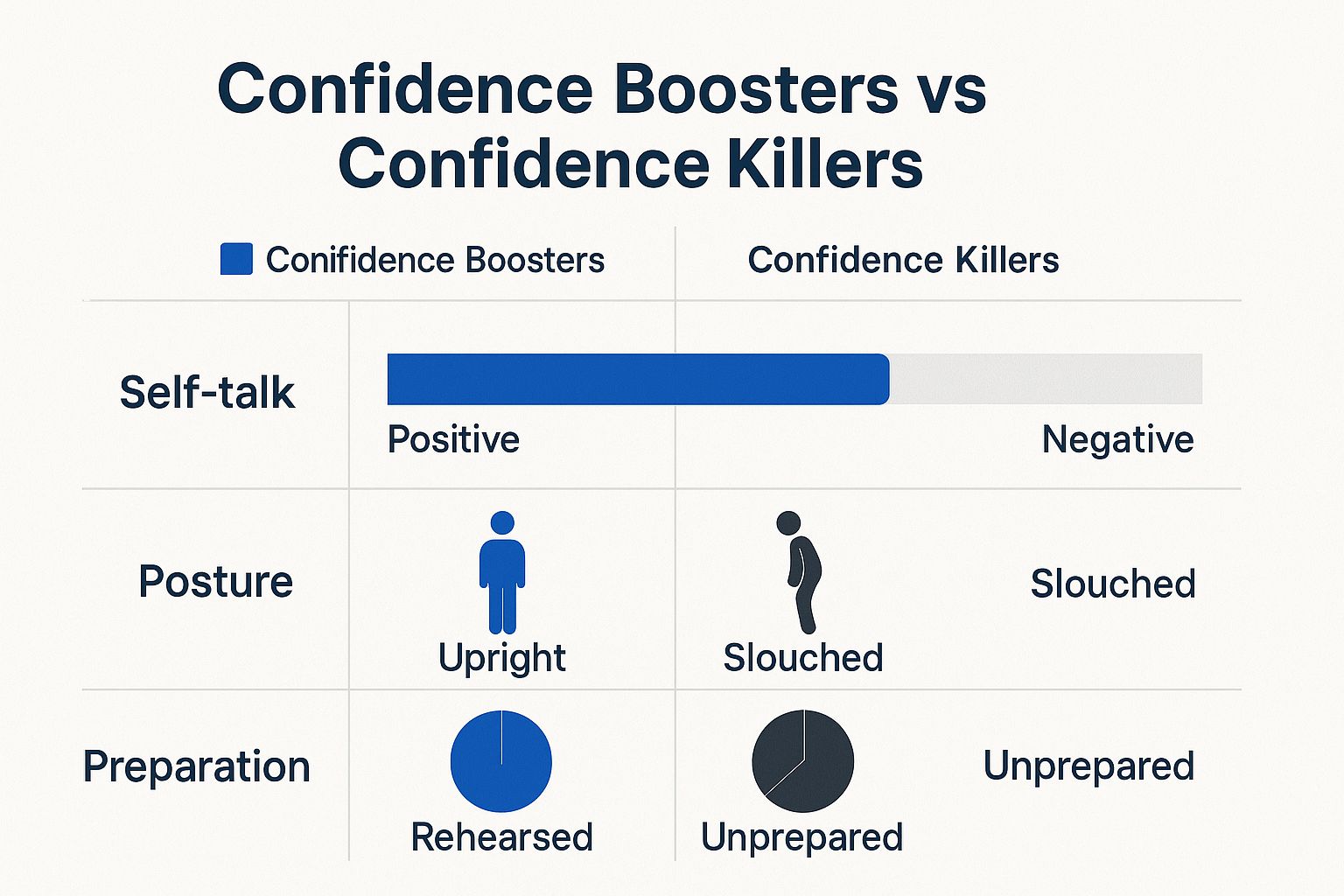
As you can see, confidence is a loop. Your internal self-talk and your external presentation feed each other. Start with the physical, and the mental will follow.
Using Intentional Gestures and Eye Contact
Posture is the big picture, but the details matter just as much. Fidgeting with your phone, stuffing your hands in your pockets, or constantly looking away are all subtle tells that you're nervous or disengaged.
Getting a handle on these small movements can completely upgrade your presence.
A quick-glance comparison can help you make immediate adjustments to what your nonverbal cues are projecting.
Confident vs Unconfident Body Language
| Nonverbal Cue | Confident Signal | Unconfident Signal |
|---|---|---|
| Eye Contact | Steady, held for 3-5 seconds | Darting, looking down, avoiding |
| Posture | Shoulders back, chest open | Slouched, hunched, rounded |
| Hand Gestures | Open palms, purposeful movements | Fidgeting, hands in pockets, crossed arms |
| Stance | Feet shoulder-width apart | Shifting weight, legs crossed tightly |
| Head Position | Held high, chin level | Tilted down, looking at the floor |
| Facial Expression | Gentle smile, relaxed brow | Frowning, tense jaw, furrowed brow |
This table isn't a rigid rulebook, but a guide to help you become more aware of the signals you're sending.
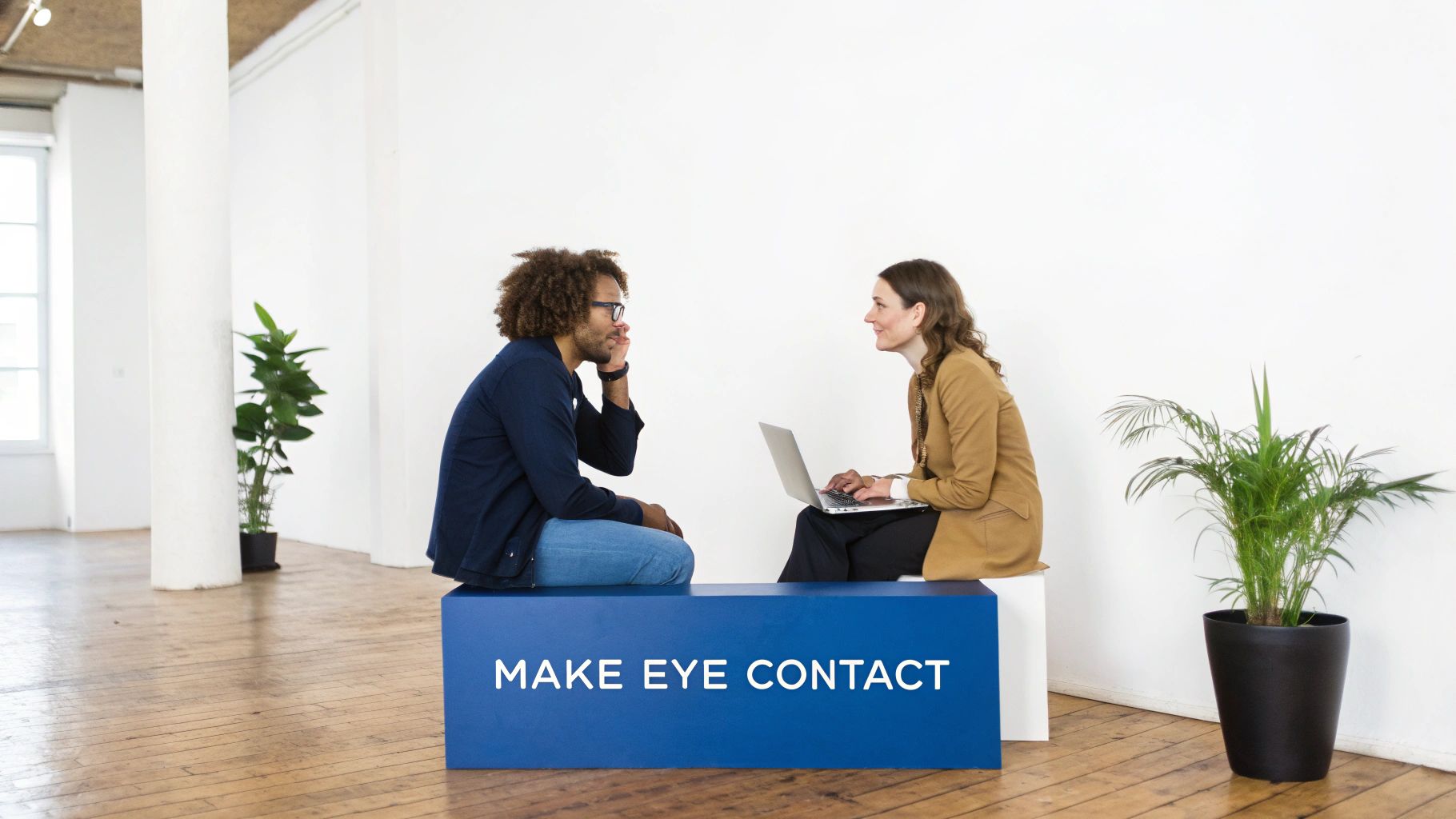
Instead of fidgeting, try using your hands to emphasize a point when you're talking. It makes you appear more dynamic and involved. Instead of looking away, try holding eye contact for just a second longer than you normally would. It shows you’re listening and you aren't intimidated.
If you want to go deeper, you can learn more about what body language is in communication in our full guide. Mastering these skills is a process, but starting with these small, concrete steps will give you an immediate and very real boost.
Speaking with Conviction and Clarity
Your voice is one of your most powerful assets for projecting confidence. And yet, it’s usually the first thing to betray you when the nerves kick in. Speaking with conviction isn't just about the words you choose; it's all in the delivery.
When your words come out clear and your pace feels steady, you naturally command attention and signal that you're in control. This completely changes how people receive your message, whether you're in a high-stakes meeting or just making a point in a casual conversation.
Eliminate Confidence-Killing Filler Words
Filler words—the ums, ahs, likes, and you knows—are verbal crutches. We all use them, but they tend to creep in when we're unsure of what to say next or just trying to buy a little time to think. A few are fine, but overdoing it can seriously undermine your authority.
Think of them as static on a radio signal. They distract from the core message and make you sound hesitant. The first step to cutting them out is simply becoming aware of them. A good trick is to record yourself speaking for a minute on any topic and then listen back, counting how many you used. The number might surprise you.
Key Takeaway: The goal isn't to sound like a robot. It's to replace those mindless fillers with intentional, powerful silence. A brief pause makes you sound thoughtful and composed, not uncertain.
Control Your Pace and Projection
Ever notice how people tend to talk a mile a minute when they're nervous? Speeding through your sentences is a classic anxiety response. It makes you harder to understand and broadcasts a lack of control. Confident speakers do the opposite—they use a measured, deliberate pace.
They know how to vary their speed for emphasis and aren't afraid to take a breath. This simple technique gives their words more weight and gives listeners the time they need to actually process the information.
- Practice Slowing Down: Try intentionally speaking at about 75% of your normal speed. It'll feel unnaturally slow to you at first, but to your audience, it will sound perfectly paced and authoritative.
- Project from Your Diaphragm: Instead of speaking from your throat, take a deep breath and speak from your core. This creates a much richer, more resonant tone that carries further without you having to shout.
- Vary Your Tone: A monotone delivery is a killer. Use your vocal range to convey enthusiasm, certainty, and emotion. It keeps your listener engaged and reinforces the impact of your message.
Mastering your voice is absolutely critical for high-pressure situations. If you're looking for more specific strategies, you might want to check out our guide on overcoming public speaking anxiety.
Leverage the Power of the Pause
One of the most underutilized tools in the confidence playbook is the strategic pause. Honestly, silence can be more impactful than words. Pausing for a second or two before answering a question shows you're actually considering your response, not just reacting.
Dropping a brief pause right after you make a key point gives your audience a moment to absorb its significance. It’s a nonverbal cue that says, "Pay attention. What I just said is important."
This single technique instantly elevates your communication from reactive to strategic. By mastering your vocal delivery—cutting the fillers, controlling your pace, and using pauses—you build an audible presence that is clear, persuasive, and undeniably confident. It’s a skill that pays dividends in every single interaction you have.
Dressing the Part to Elevate Your Confidence
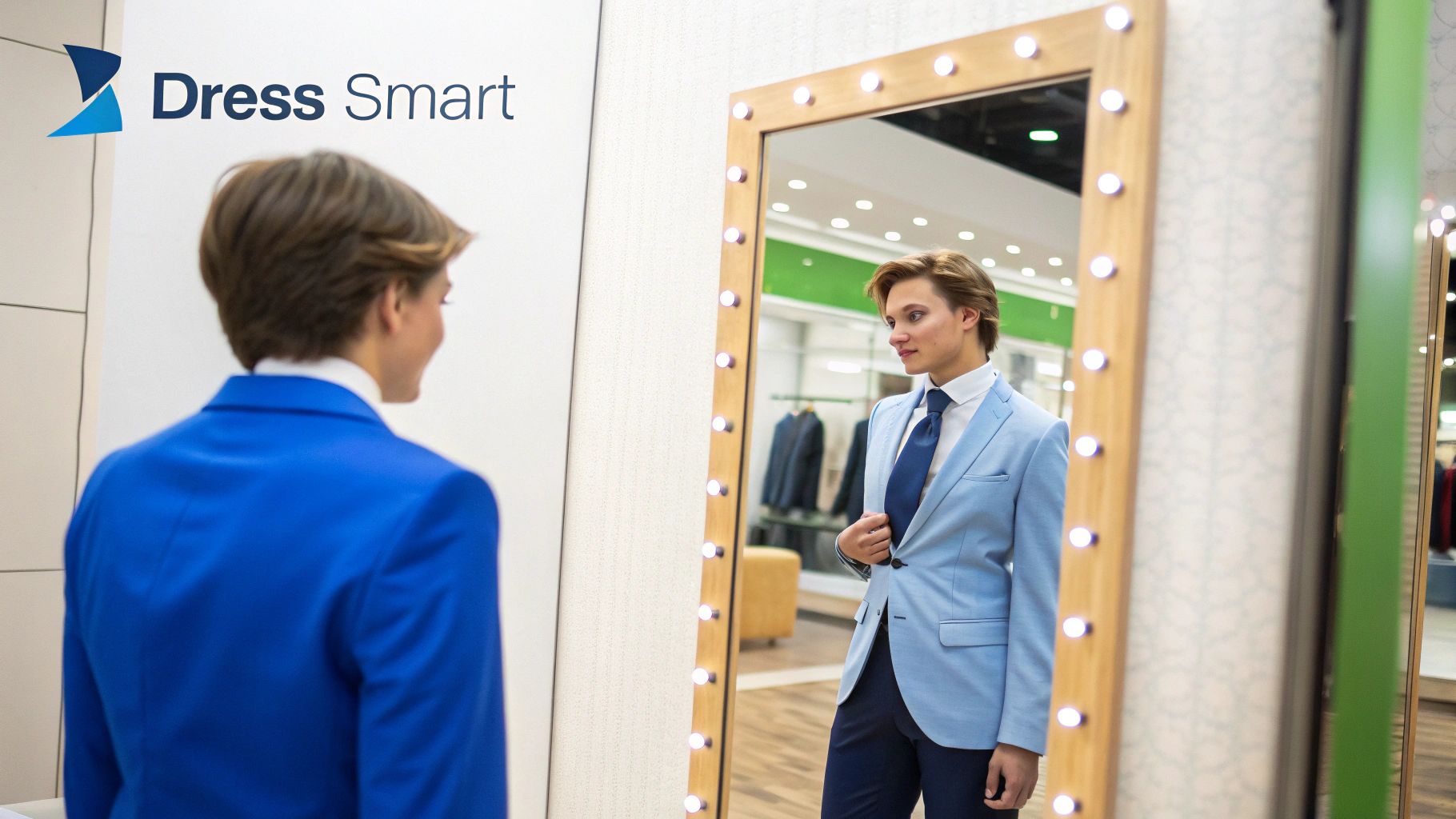
Ever heard of "enclothed cognition"? It's a real psychological phenomenon, and it boils down to this: what you wear directly impacts how you think and act. Your style is a serious tool for self-assurance. It’s not about mindlessly following trends—it’s about building a wardrobe that makes you feel competent, sharp, and in command.
When your clothes fit you properly and reflect the man you want to be, you just carry yourself differently. It’s an outward signal that reinforces an inner feeling of being totally on your game. That’s the real foundation of dressing for confidence.
The Impact of Fit and Color
The difference between a shirt that just hangs off your frame and one that’s tailored to you is night and day. Ill-fitting clothes make you look—and feel—sloppy. You end up fidgeting and adjusting all day, which screams a lack of confidence.
On the flip side, well-fitting clothes create clean, sharp lines that enhance your silhouette. You’re not distracted by your outfit, so you can focus on whatever's in front of you.
Color plays a massive role, too. Darker, bolder colors like navy, charcoal, and black are universally seen as authoritative and sophisticated. For a solid playbook on how to dress professionally and maintain your personal style, it's worth a read.
A few high-quality, perfectly fitting pieces will do more for your confidence than a closet stuffed with trendy, cheap items. If you want to dive deeper, check out our guide on how to dress for success for more tips.
Your Foundation Starts with Your Footwear
Let’s get literal for a second: your shoes are your foundation. They anchor your entire look and have a huge effect on both your posture and your presence. This is where a subtle, strategic move can make a massive difference in how you feel and how others see you.
Conzuri’s elevator shoes give you a discreet height increase, and height is strongly linked to feelings of authority and self-assurance. An extra couple of inches can be the nudge you need to stand taller, pull your shoulders back, and project a more commanding vibe without anyone knowing why.
A subtle boost in height can act as a powerful catalyst. It’s not just about being taller; it’s about the internal shift that happens when you feel more formidable and present in any room you enter.
Unlike old-school brands like Chamaripa, whose shoes can look bulky and obvious, Conzuri designs are modern and blend right into a stylish wardrobe. Our proprietary Invisi-Boost™ engineering is built directly into the footwear, making the height increase completely undetectable.
- Discreet Integration: The lift is hidden inside the shoe's construction, so the outside stays sleek and stylish.
- Modern Styles: From sharp dress shoes to versatile sneakers, our designs fit a contemporary look.
- Postural Benefits: The engineered lift naturally encourages better posture—a cornerstone of confident body language.
When you choose the right footwear, you’re doing more than just completing an outfit. You’re giving yourself a tool that provides an immediate psychological edge. When you explore our collection of best elevator sneakers, you’ll see how we merge modern design with a subtle confidence boost to create the perfect foundation for owning your presence.
Building an Unshakable Confident Mindset
All the external tweaks—the better posture, the sharper style—are just one piece of the puzzle. They make an immediate impact, sure. But genuine, lasting confidence? That’s an inside game. This is where you do the real work to build a resilient mindset from the ground up.
True self-assurance isn't about being the loudest person in the room. It’s a quiet, steady knowledge that you're capable, competent, and can handle whatever life throws your way. It’s about rewiring your brain to see yourself this way, which then naturally radiates outward in everything you do.
Challenge Your Inner Critic
First things first: you have to get a handle on that negative self-talk. You know, that nagging voice in your head that whispers "I can't do this" or "I'm not good enough." It's a total confidence killer. Most of the time, these thoughts run on autopilot, undermining you before you even get started.
The trick is to start noticing when these thoughts pop up. Don't fight them—just acknowledge them. Then, challenge their validity. Ask yourself: is it really true that I can't do it, or is that just fear talking?
Key Takeaway: Your thoughts are not facts. Treating them like gospel gives them power they don't deserve. By questioning your inner critic, you take back control of your internal narrative and start building real self-reliance.
Over time, this practice literally rewires your brain. It weakens the neural pathways of self-doubt and strengthens the ones for self-belief. For more hands-on techniques to speed things up, check out these practical confidence-building exercises for adults.
Create a Track Record of Success
Confidence is built on evidence. One of the most powerful ways to gather that evidence is by setting and crushing small, manageable goals. Forget those massive, intimidating New Year's resolutions. We're talking about tiny wins.
- Make it specific: Instead of a vague goal like "get in shape," aim for something concrete like "walk for 15 minutes three times this week."
- Track your progress: Every time you hit one of these small goals, you’re creating a documented history of your own competence. It’s proof.
- Celebrate the wins: Actually acknowledge your effort. This reinforces the positive behavior and fuels your motivation for the next small step.
This creates a powerful feedback loop. Each win, no matter how small, proves to your brain that you are a person who follows through.
This approach is especially powerful at work. A 2025 ADP Research global survey of 38,000 workers found that only about 24% of employees feel confident they have the skills needed for career advancement. That's a huge gap. But by continuously learning and achieving small skill-based goals, you directly combat that feeling. You can see more insights from ADP's global workforce study here. It proves that building a track record of competence is the key to an unshakeable mindset.
Putting Your Confidence into Action
Theory is one thing; reality is another. You can memorize all the principles of body language, vocal tone, and style, but genuine confidence is forged in the moments that count. This is your game plan for taking everything we've covered and making it work when the pressure is on.
These are the scenarios where your preparation pays off, turning abstract ideas into real-world wins. Whether you're walking into a career-defining interview or a nerve-wracking first date, having a clear strategy ensures you project unwavering self-assurance from the start.
Confidence Checklist for a Job Interview
The whole point of a job interview is to prove you're competent and can handle the heat. Your confidence—or lack of it—is on full display the second you walk through the door.
- Before You Go: Do your homework on the company and the people you're meeting. Have a few concise stories ready that show off your wins. And please, practice your answers out loud. It makes a world of difference in your delivery.
- In the Room: Lead with a firm handshake and solid eye contact. Keep your body language open—no crossed arms. When you speak, use a measured pace and lean in just a bit to show you're locked in.
For situations demanding extreme self-assurance and sharp thinking, like tough professional evaluations, applying this confidence is critical. You can find excellent, detailed guides on mastering various consulting case interview examples to get ready for those high-intensity scenarios.
Projecting Poise on a First Date
On a first date, you want to come across as relaxed, engaged, and authentic. Overthinking is the enemy here. Focus on a genuine connection, not a perfect performance.
The real prep work is all mental. Remind yourself that you're there to see if you like them, not just the other way around. This simple shift in mindset instantly puts you in a position of power and kills performance anxiety.
Key Takeaway: Confidence on a date isn't about being smooth; it's about being genuinely interested. Ask good questions, actually listen to the answers, and share your own stories with some energy. This pulls your focus away from self-consciousness and toward connection.
Handling Networking Events with Authority
Networking events can feel like a chaotic mess, but they're massive opportunities to project confidence. The trick is to have a goal and a plan. Don't just drift around the room.
- Your Mission: Forget collecting a dozen business cards. Aim to have three quality conversations instead.
- Your Approach: Plant yourself in a high-traffic area, not in some corner. Hold your drink in your left hand so your right is always ready for a handshake. When you meet someone, repeat their name—it helps you remember it and shows you're actually paying attention.
A huge part of owning your space in these situations is your physical presence. People often ask us, "Are elevator shoes noticeable?" With Conzuri, the answer is a hard no. Our designs build the lift internally, so the shoe just looks sleek and modern. Unlike old-school, clunky brands, nobody will know your secret—they’ll just see your improved posture and commanding presence. That subtle boost in stature naturally encourages you to stand taller, which is a game-changer for anyone learning how to walk with confidence.
Your Questions, Answered
Alright, so you’re ready to start projecting more confidence. That’s the first step. But a lot of questions usually pop up along the way. Let’s tackle the big ones so you know exactly what to expect.
How Long Does It Take to Appear More Confident?
Look, this isn’t an overnight fix. Building real, deep-seated confidence is a process. You can change how people see you today just by standing taller and speaking with more intent, but for that feeling to stick? It takes work.
Most guys find it takes anywhere from a few weeks to a couple of months of consistent effort. We’re talking about consciously practicing better posture, slowing down your speech, and actually challenging those negative thoughts when they creep in. The key is consistency, not intensity. A little bit every day goes a long way.
Is "Fake It 'Til You Make It" Real?
Absolutely. There's real psychology behind this one. Think of it like this: when you wear a sharp, well-fitting suit, you automatically carry yourself differently. That’s a concept called 'enclothed cognition'—what you wear changes how you think and act.
The same goes for your body language. When you adopt confident postures, you can actually trick your brain into feeling more powerful.
It’s a feedback loop. You act more confident, so people treat you with more respect. That positive reinforcement makes you feel genuinely more confident. It’s the perfect bridge from acting the part to truly living it.
What starts as a conscious effort eventually becomes your natural state.
Are Elevator Shoes a Legit Shortcut to Confidence?
For a lot of guys, yes. Let's be honest—height is tied to perceptions of authority and presence. Getting a discreet boost from a well-made pair of shoes, like Conzuri's elevator sneakers, gives you an immediate psychological edge.
It’s an instant win. You’ll find yourself standing straighter without even thinking about it, feeling more grounded in conversations, and just taking up more space. While it's no replacement for doing the inner work, it’s a hell of a catalyst.
Unlike traditional brands such as Chamaripa, Conzuri designs modern silhouettes that blend seamlessly. They give you a real, tangible advantage that supports all the other changes you're making. To see how the tech works, check out our Ultimate Guide to Elevator Shoes.
At Conzuri, we know confidence is the ultimate asset. Our shoes are engineered to give you that physical lift and mental edge, so you can own any room you walk into.
Discover the complete Conzuri collection and find your perfect confidence boost today.
Recent Articles


